

In Congress, July 4, 1776
The unanimous Declaration of the thirteen united States of America, When in the Course of human events, it becomes necessary for one people to dissolve the political bands which have connected them with another, and to assume among the powers of the earth, the separate and equal station to which the Laws of Nature and of Nature’s God entitle them, a decent respect to the opinions of mankind requires that they should declare the causes which impel them to the separation.
We hold these truths to be self-evident, that all men are created equal, that they are endowed by their Creator with certain unalienable Rights, that among these are Life, Liberty and the pursuit of Happiness.–That to secure these rights, Governments are instituted among Men, deriving their just powers from the consent of the governed, –That whenever any Form of Government becomes destructive of these ends, it is the Right of the People to alter or to abolish it, and to institute new Government, laying its foundation on such principles and organizing its powers in such form, as to them shall seem most likely to effect their Safety and Happiness. Prudence, indeed, will dictate that Governments long established should not be changed for light and transient causes; and accordingly all experience hath shewn, that mankind are more disposed to suffer, while evils are sufferable, than to right themselves by abolishing the forms to which they are accustomed. But when a long train of abuses and usurpations, pursuing invariably the same Object evinces a design to reduce them under absolute Despotism, it is their right, it is their duty, to throw off such Government, and to provide new Guards for their future security.–Such has been the patient sufferance of these Colonies; and such is now the necessity which constrains them to alter their former Systems of Government. The history of the present King of Great Britain is a history of repeated injuries and usurpations, all having in direct object the establishment of an absolute Tyranny over these States. To prove this, let Facts be submitted to a candid world.
The US Declaration of Independence, approved by 12 of the 13 American colonies (NY abstained but ultimately approved on July 9th) and signed by 34 delegates on July 4th, 1776 (the rest signed on August 2nd)
The uniform, constant, and uninterrupted effort of every man to better his condition… is frequently powerful enough to maintain the natural progress of things toward improvement, in spite both of the extravagance of government, and of the greatest errors of administration. Like the unknown principle of animal life, it frequently restores health and vigour to the constitution, in spite, not only of the disease, but of the absurd prescriptions of the doctor.“
Adam Smith, Wealth of Nations, published March 9th, 1776
My family has lived in the Americas since long before it was The United States of America. On my father’s side I have two ancestors who arrived on the Mayflower (Stephen Hopkins, a signer of the Mayflower pact) and Colonel Isaac Allerton (whose son married Fear Brewster, the daughter of Elder William Brewster, the religious leader of the Pilgrims). Most of my ancestors were patriots and fought for the colonies, especially the ones in the south (Calhoun, Youngblood) but the New England faction most likely had loyalists among their number (Kent, Bailey and Walker). An interesting happenstance is the story of Thomas Youngblood (1745-1822), a cattle drover who drove herds of livestock through the wilderness to keep the Continental Army fed (he is an official DAR patriot). He was from Edgefield County, SC part of which later became Aiken County, where I reside today. His son was married in Augusta, GA at a church on Broad St. in 1799, about 20 miles from my house. It is odd to me that I ended up a mere 20 miles from where one of my ancestors lived over 225 years ago. A lot of water under our family bridge over that time.
I have ancestral connections to two founding fathers, Carter Braxton and Richard Dobbs Spaight (who signed the US Constitution). I have multiple ancestors who fought in the War of 1812: Jesse Sinclair, John Strickland and Benjamin Youngblood. I had relatives who fought for the Union in the Civil War (James Copeland) and ones who fought for the Confederacy (Calhoun, Youngblood, Danley). The Danley family is particularly interesting because members of the family were present on both sides of that awful war. I have personal memories of relatives who fought in WWI and WWII. My father served two tours in Vietnam (as a civilian employee of CAAG, a group funded by USAID). I served 8 years in the US Navy submarine service and my cousin (just a little younger than me) is a Naval Academy graduate who started as a pilot and ended his career teaching at the Academy. My sister is retired from the US Air Force.
I and my family are about as American as you can find outside of actual natives, but this lineage doesn’t confer any special benefits. Parts of my family have been wealthy (Allerton and Calhoun, antebellum) while others were poor (Calhouns after the Civil War) and some experienced both in their lifetime (Braxton). My father (born in 1935, right in the middle of the Great Depression) and his two brothers lived part of their childhood in extreme poverty after their mother divorced their father (another Joseph Y. Calhoun). It was a tough start but like a lot of Americans, they overcame it, had successful careers and raised wonderful, successful families.
That phrase “life, Liberty and the pursuit of Happiness” is the sin quo non of what it means to be American. Our country was born the same year Adam Smith’s Wealth of Nations was published and it might as well have been a blueprint. We Americans are always striving to make ourselves better, however we define that. We are free to try, to succeed and to fail and start all over again with a clean slate. Adam Smith told us that government wasn’t the answer to our problems, that it was free people (okay in Smith’s day it was men but I’d put my granny in her prime up against any man) pursuing their own interests that was “powerful enough to maintain the natural progress of things toward improvement, in spite of the extravagance of government”. The pursuit of happiness wasn’t a guarantee of success, of happiness. It was a demand that the government get out of the way so citizens could pursue it themselves.
Today, it often feels like government is not something in which we participate so much as something that is imposed upon us. As government has gotten larger and larger, its scope expanded so far beyond the boundaries of any concept of limited government, it has become more and more remote from the people it is supposed to serve. Government, as envisioned by the founders, was intended to be a referee, enforcing basic rules but otherwise allowing the market to decide who the winners and losers will be. Instead, today it often feels like the government – or more accurately the politicians who make it up – has its thumb on the scale in favor of its benefactors (who definitely aren’t you and I), favoring one group of Americans over another. The US government today is securing ownership in private companies, guaranteeing loans to others and imposing its will through selective tariffs, subsidies and bailouts. Government decides, to some degree, the winners and losers in advance.
We are told daily that we are a nation hopelessly divided and in some ways I guess we are. But we need to recognize that the polarization is intentional, a product manufactured by the political class who benefit from it. Polarization benefits no one but the politicians who want nothing so much as to stay in power. But it isn’t the soul of our country, it isn’t America.
America is the retired couple I know who canceled their vacation, loaded their car with supplies and tools and drove to western North Carolina after Hurricane Helene to help anyone who needed it. It is the private companies and individuals who donated time and equipment to fly supplies to those stranded in the mountains when the federal government was still trying to figure out what happened and politicians were using the disaster to score political points for an upcoming election. It’s about thousands of volunteer fireman across this great country who don’t care whether you you support team red or team blue, only that you need help. It’s a community that spends days or weeks looking for a missing child, no matter the skin color. It’s about neighbors suddenly becoming friends in the wake of a natural disaster. It’s about the families who take in foster children who have nowhere else to go. These are the things that make America great and there is no need to add “again”; we never stopped.
And it is also about the amazingly resilient US economy, one that has been declared washed up many times in my lifetime, from the malaise of the 70s, to the S&L crisis of the 80s, to the dot com crash of the ’00s, to the great financial crisis of 2008, to the COVID pandemic of the early ’20s. It is about the economy today, continuing to grow at trend despite the chaos of the Iran War, the endless executive orders and policy changes and crony/nepo capitalism run amok.
Capitalism is not something imposed from on high; it is a bottom up process, driven by millions of individuals, most of whom are doing their best to tune out whatever Washington, DC is talking about this week. It is Americans, individuals, entrepreneurs, waking up every day trying to figure out how to solve problems, cut costs, get more efficient and, above all, to serve their customers. I hear every day that America isn’t what it used to be and see the polls that say the same thing, that the American dream is now beyond the grasp of younger generations.
And yet, new business formation continues to rise and technology continues to emerge to help those courageous individuals not only pursue happiness, but achieve it. Individuals and companies continue to spend and take risks and create new jobs, some that didn’t even exist a couple of years ago. While the political arena is a circus of manufactured outrage and finger pointing, the American economy is driven by a quiet, underlying foundation of Americans who just want to build things, solve problems and keep moving forward toward something better. It may be because they want something better for themselves, but through that “uniform, constant, and uninterrupted effort of every man to better his condition”, we all benefit.
I can trace the economic history of the American experience through my own family tree. I have ancestors like Col. Isaac Allerton who built immense fortunes, and Carter Braxton who lost everything to the tides of revolution. I have Mayflower Pilgrims who started with nothing but dirt floors, and 20th-century grandparents in the rural South who scratched out a living during the Great Depression.
I am proud of my country and my family’s role in its creation and development but I don’t expect any special treatment just because I had ancestors who came here a long time ago. When I hear some people today talk about “heritage Americans”, I wonder how they could have been here so long and learned so little. Nobility in America isn’t inherited and it doesn’t come with a big bank account or stock options or an unhealthy dose of xenophobia. It is earned by acting with high moral principles, courage, and selflessness.
The lesson for us as investors is profound: Fortunes come and go. Governments rise, impose their will, print money into oblivion, and destroy wealth through their errors. But the one constant—the ‘unknown principle of animal life’ that Adam Smith wrote about—is the human capacity to survive the poverty, adapt to the chaos, and start building again from the bottom up.
We don’t invest because we think the current political system is perfect or because we trust the politicians in power. We invest because history proves that whether starting from a mud hut in Plymouth or a depression-era farm in Louisiana, the natural progress of human ingenuity will always find a way to overcome the drag of the state and prosper anyway.
When we invest in America, we aren’t betting on the politicians in DC. We’re betting on those Americans who have the will and the grit to succeed in spite of them.
Joe Calhoun
Quick Market Update
The economy is growing at its long-term growth trend of 2 to 2.5% but inflation is stubbornly above the Fed target of 2%. There has been little variation in that trend for the last four years. We can see that economic stability clearly reflected in markets via the 10-year Treasury yield and the dollar. One thing we can say with some conviction about what has happened after the COVID recovery is that economic stability is good for corporate profits and the stock market. But it may already be sowing the seeds of its own destruction, so to speak.
What I’m talking about his Hyman Minsky’s Financial Instability Hypothesis which posits that stability breeds complacency which leads to instability. When you’ve had a long period of low volatility growth, companies start to take risks that only make sense as long as things stay stable. According to Minsky, we go through a cycle of debt from Hedge Borrowers (can repay interest and principal from cash flow) to Speculative Borrowers (can only make interest payments with cash flow) to Ponzi Borrowers (can pay neither interest nor principal from cash flow). I would argue that we have entered a new phase of this cycle with the emergence of AI. We have been in the speculative phase for quite a while (the rise of the private credit markets) but we may be entering the Ponzi stage now with the market financing AI companies with nothing more than hope and a data center. With outflows mounting in private credit funds, I am concerned about the possibility that we are nearing a Minsky Moment, when things shift suddenly from stable to unstable. I’m afraid I’ll be writing more about Mr. Minsky and his moment in the coming months.
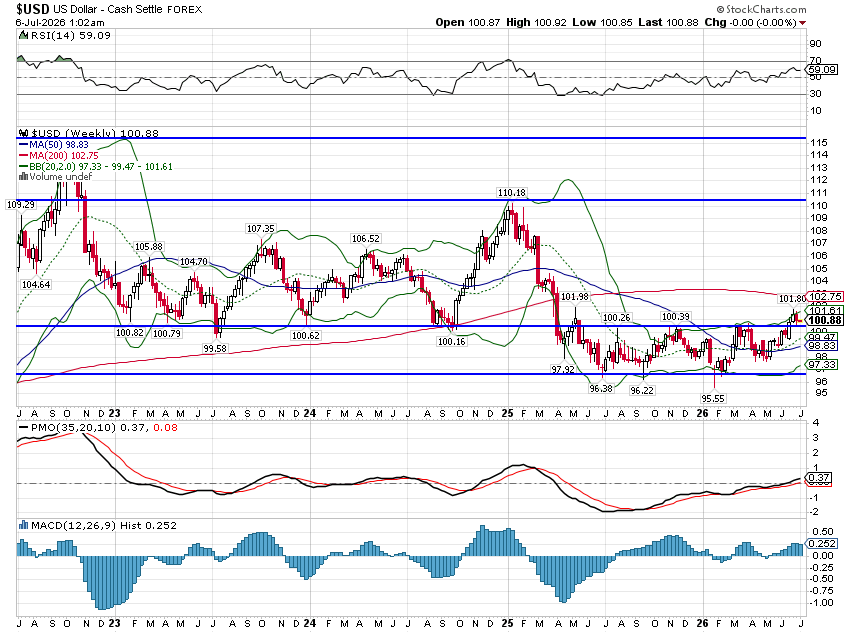
The dollar remains in the lower end of the range it has established over the last 4 years. The buck broke out to almost 102 on the back of rising rates due to the Iran War, but now appears to be fading. There is still some possibility that the rally continues but that will depend to a large degree on how the economic data comes in over the next few weeks. That data today continues to point to a further acceleration in the US and right now I don’t see that the rest of the world is slowing any more than the US. The dollar’s stability reflects the stability of the relationship between US and non-US growth.
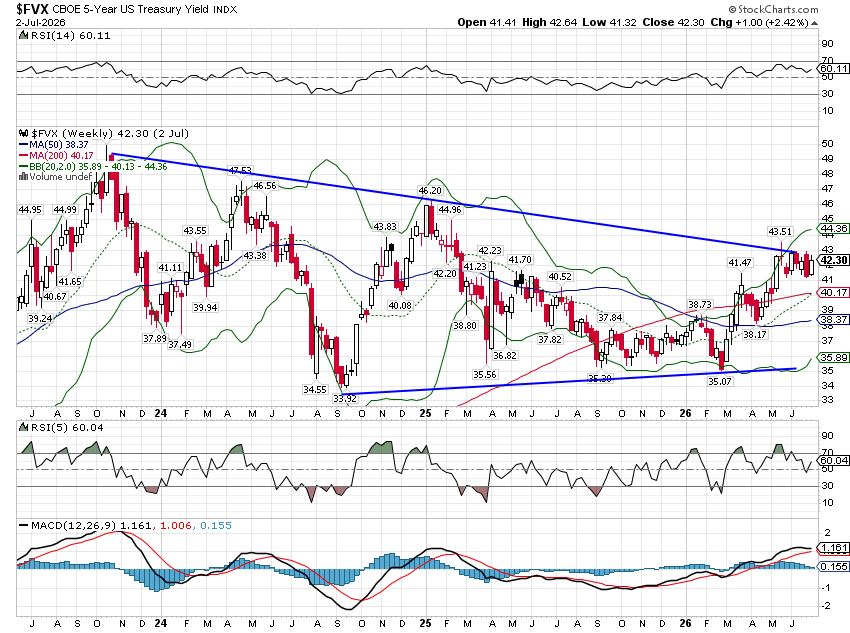
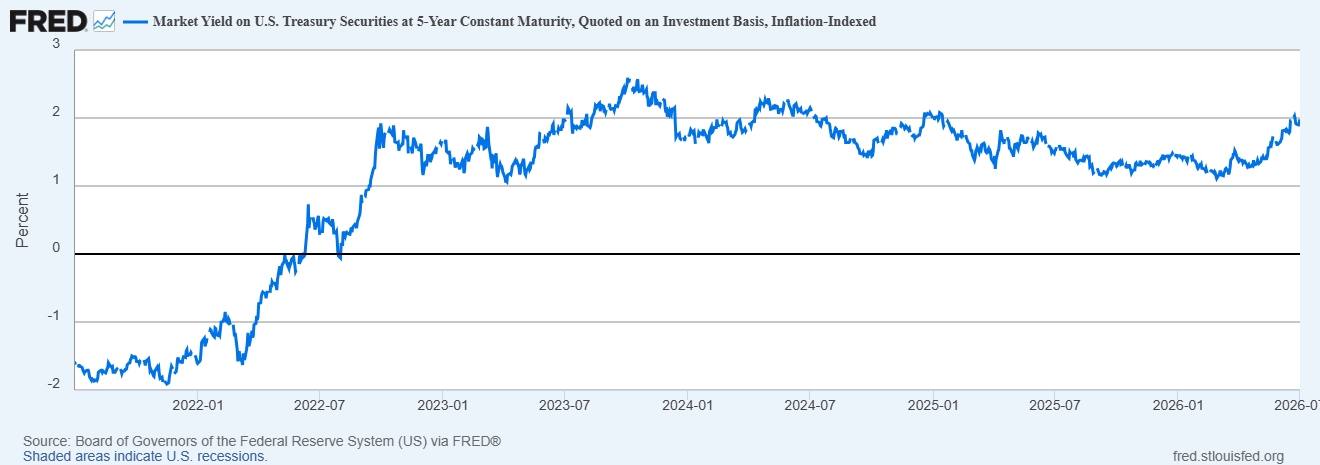
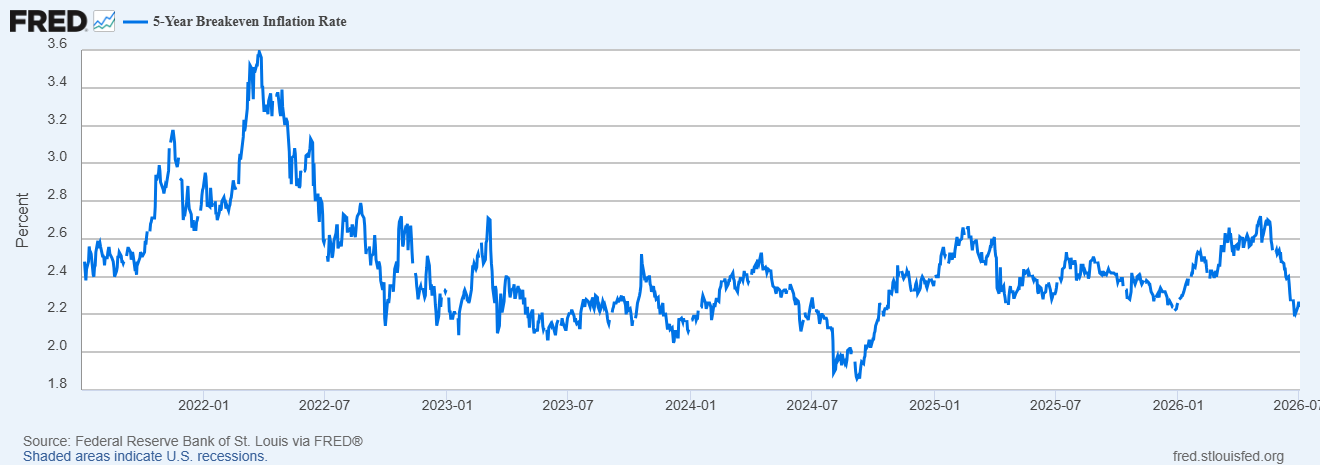
Nominal growth expectations have been on the rise as short term and long-term interest rates are up since the end of February. Surprising maybe to a lot of people, is that it isn’t all about crude oil-fueled inflation expectations. Real rates have been rising too and in the case of the 5-year TIPS, more than its nominal cousin; the 5-year TIPs yield is up 87 basis points since 2/27 while the 5-year nominal treasury yield is up 72 basis points. That 15 basis point difference is how much inflation expectations have fallen since the start of the Iran War. The war affected the headlines and the stance of the Fed but, so far at least, the market isn’t buying it.
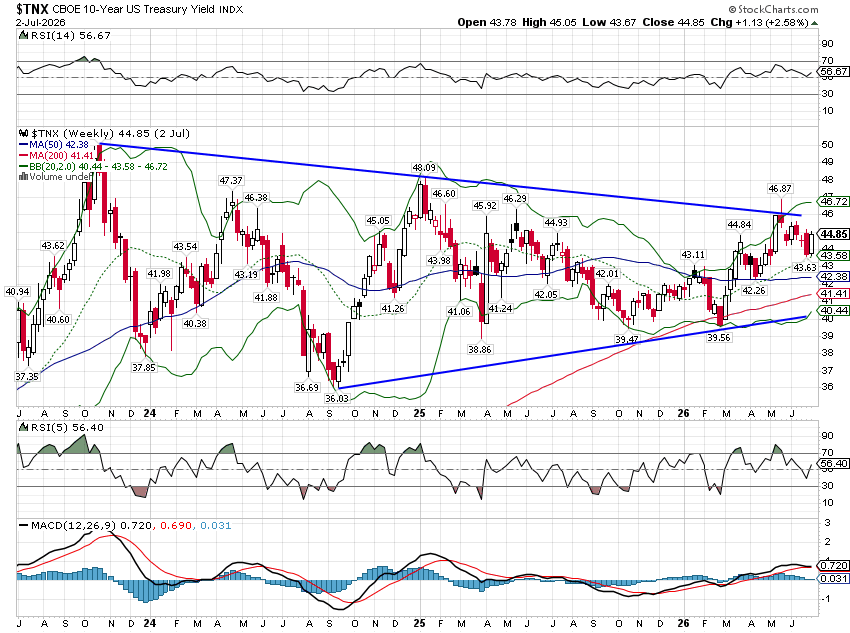
The real news is that rates are also still in the range they’ve been in for the last 4 years but at the top rather than the bottom. The rise in real rates is a natural response to rising demand for capital to invest.
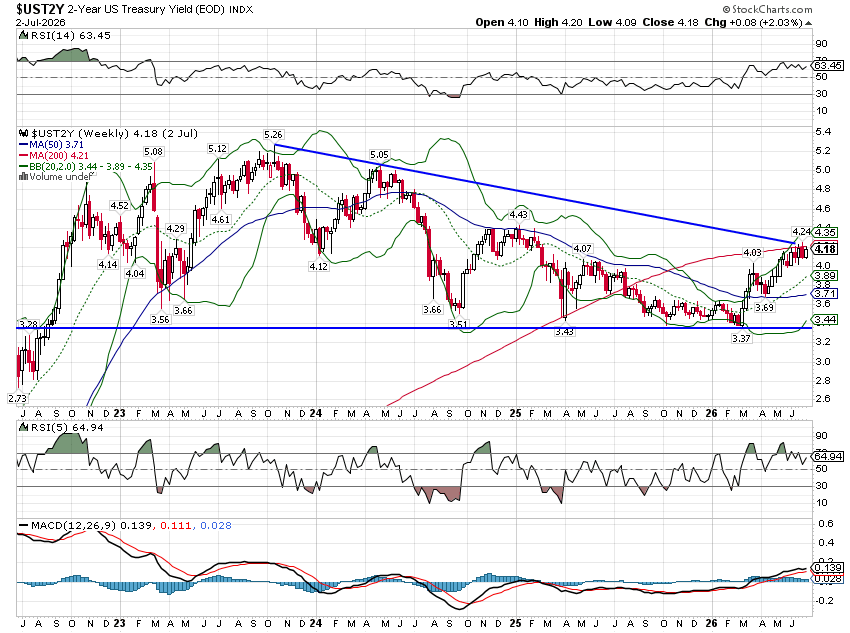
The 2-year nominal Treasury yield has also risen recently. The 2-year yield largely reflects expectations for Fed policy over the next couple of years and that has turned more hawkish in recent weeks.
The 10-year yield has also risen and it is also a story of real growth with the rise in 10-year TIPS yield matching the nominal change; no change in inflation expectations.

Stay In Touch