

Come writers and critics
Who prophesize with your pen
And keep your eyes wide
The chance won’t come again
And don’t speak too soon
For the wheel’s still in spin
And there’s no tellin’ who
That it’s namin’
For the loser now
Will be later to win
For the times they are a-changin’
– Bob Dylan, The Times They Are A-Changin’, 1964
The FOMC met last week and voted unanimously to raise the Fed Funds target by 0.25%. That’s a minor change and shouldn’t be expected to have much impact by itself but expectations for future hikes are rising. The CME’s Fed Watch tool currently shows a better than even chance of a further hike at next month’s meeting and a 44% chance of a hike in December. If you look out to the end of 2027, the odds cluster around 4.5 – 5%. That would be a minor rise compared to past hiking cycles and nearly symmetrical with the 1.75% they shaved off rates over the last two years. One can’t help but wonder if the economy would look any different today if the FOMC had just taken an extended vacation.
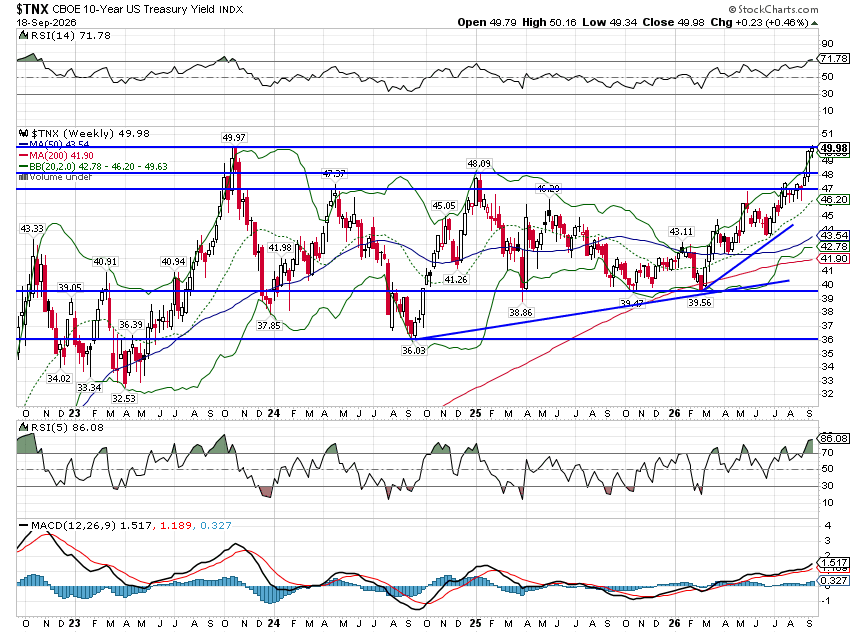
We see similar expectations across the Treasury complex with the 2-year yield closing Friday at 4.75%. The 10-year Treasury yield is on the verge of breaking out of the range it’s been in for the last 3 years, closing Friday at 4.99%. It moved above 5% briefly last week but wasn’t able to stick. Absent some news that lowers growth or inflation expectations – which is certainly possible – I think one must assume that the rate will continue to rise. As for how high it might go, I think the market may be underestimating the potential.
We know that the 10-year rate and the year-over-year change in NGDP tend to track each other closely. While divergences can last a while, eventually they end up in about the same place. With the most recent YoY NGDP change at 6.6% and the 10-year at 4.99%, one would expect that either the 10-year rate will rise or the rate of change of NGDP will slow. Additionally, the narrow gap between the 2-year and 10-year yield is an indication the market does not expect the 10-year rate to rise significantly from here. (The 10-year rate is just a series of 2-year rates). If the 10-year rate is near its expected high, that would mean the change in NGDP growth will be what brings them back into line. A 1.6% drop in NGDP is a lot and we have no idea whether that drop would be from lower inflation or weaker real growth.
I’m not sure exactly why the market is pricing this outcome now but it seems unrealistic to me. In an inflationary environment, the 10-year yield usually needs to rise above NGDP growth to kill the inflation.
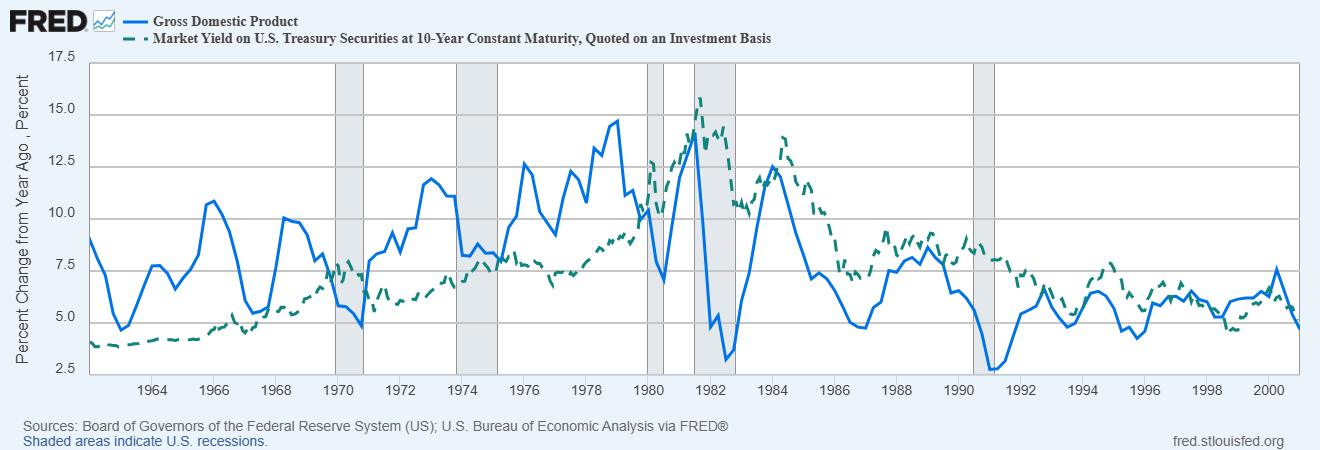
From the early 60s to the early 80s, the 10-year rate was consistently below the change in NGDP and inflation kept rising. It wasn’t until the early 80s when the 10-year rate rose above NGDP growth that inflation started to ebb. There are periods when this doesn’t hold, most recently from 2010-2019, so the spread is more an effect than a cause. Inflation comes from a drop in the value of the dollar. It isn’t a mystery why dollars weren’t in great demand in the 70s when Treasuries were offering negative real returns, we were impeaching a crooked President and our economy was producing the AMC Pacer and the Ford Pinto.
There are obviously scenarios where NGDP growth does fall. The AI buildout could slow significantly and that seems more likely today with OpenAI and Anthropic arguing for a slowing. But I do wonder what these companies really want, what they’re really lobbying the government to do. Call me crazy, but if you discover that your new product has the potential to wipe out mankind, I don’t think you need government permission to stop doing that. “Regulate me or I will be forced to keep working toward doomsday” is every bit as crazy as it sounds. So, I’m pretty sure their motives aren’t pure; I’m just not sure how. But a slowing of the AI boom is certainly possible and with so much of our economic activity currently supporting that boom, it would almost certainly reduce NGDP growth. But the AI slowdown scenario does suffer from one flaw – there’s zero evidence it is happening. At least not yet.
The other obvious scenario would be for inflation to fall and bring down NGDP growth. With much of the recent rise in the inflation figures a function of energy prices, that surely isn’t an easy path. Even if the Iran war ends tomorrow, restoring supplies of crude and refined products will take time. And in the case of diesel fuel, probably quite a bit of time. Still, markets do price the future, so prices would likely fall some, even if not all the way back to where they were before the war. And by the way, there is currently zero evidence this war will end soon.
Another scenario would be for the 10-year rate – and other rates too – to just keep rising until they get above NGDP growth and kill inflation. For investors, this is probably the ugliest scenario because it would mean a 10-year Treasury yield of 6.6% and stocks are not going to like that higher discount rate.
Lastly, it could be some combination of these scenarios, where rates rise from here and NGDP falls. Maybe that gets the 10-year up to 5.5 or 5.75%, an outcome that gets the 10-year back to its long-term average.
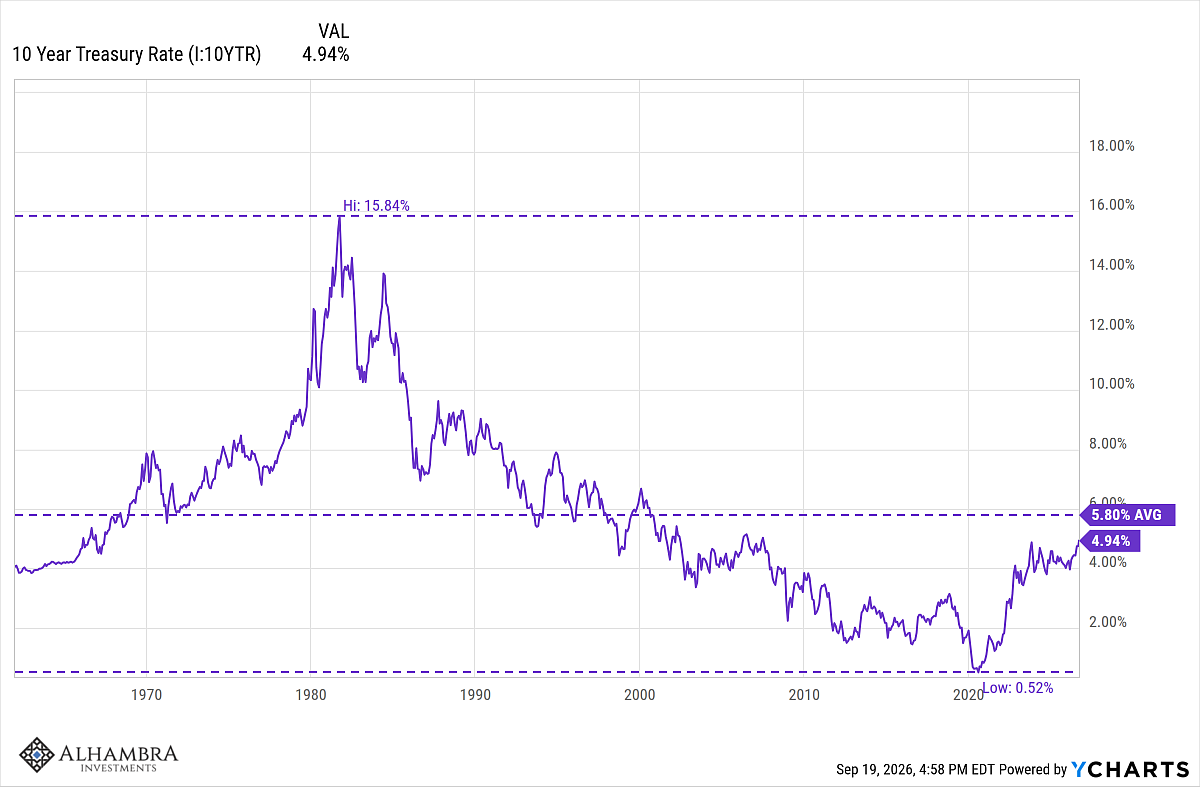
Rates haven’t been that high in a long time so it might take a bit for markets to adjust but, as you can see, rates were above this level for all of the 80s and most of the 90s so equities can certainly do okay in that environment. Of course, rates were in a downtrend then so it is a bit different but if inflation can be controlled, the market will adjust.
That is the question though; can the Fed control inflation? I have to say that I am a lot less confident about that than my younger self. As I said above, inflation is about the purchasing power of the dollar and there are many things that affect that, interest rates being only one – and a weak one at that. The dollar index is just a relative value measure but it is down over 12% in the last 4 years. It has stabilized over the last 18 months and gold appears to have calmed down but another leg down in the buck would almost certainly mean another, further rise in inflation. And even higher interest rates.
I can’t predict how all this will come out but I do think that if the 10-year yield moves firmly above 5%, we will have entered a new phase of this cycle and portfolio changes will likely be warranted. We have been in an inflationary environment since Q2 of last year but it wasn’t until recently that the ratio of inflation to real growth became uncomfortable. Right now, 2/3 of NGDP growth is inflation (6.5% total NGDP growth = 4.4% inflation + 2.1% real growth) and that leans too far away from real growth for our comfort. As long as the 10-year stays in the range its been in for the last three years there’s some hope that inflation might come back down and restore balance to NGDP. I don’t “prophesize with my pen” and I don’t want to “speak too soon, for the wheel’s still in spin” but it is prudent to prepare, for the times may be a-changin’.
Joe Calhoun

Stay In Touch