

The AI trade hit some turbulence last week as concerns emerged about the growth rate of the industry. The technology sector ETF (XLK) lost 7.7% last week and is down nearly 10% since peaking on 10/6. The semiconductor industry ETF (XSD) fell 12.5% and is nearing bear market territory (-17.3%) since peaking the same day. What’s more interesting, from a psychological standpoint, is that the technology sector, despite making a nominal new high in October, is no higher today than it was in late May. Semiconductors are even worse, down 29% since peaking on June 3rd. Despite losing money since June, these stocks have been the constant topic of conversation the entire time. The hype force is strong with this one.
The biggest damage has been to the so-called Neoclouds, the smaller, more leveraged AI suppliers. Coreweave got all the press attention as their unsecured bonds tanked and the cost of credit default swaps roughly tripled in a week; S&P put the odds of default within five years at over 60%. They might not have to wait that long. The bonds they issued in April with a 9.75% coupon are now yielding about 16%. The stock peaked in June and is down by two thirds since but the market cap is still $34 billion for a money-losing company whose bonds were junk before all this. They’ve got about $6 billion in cash versus $35.6 billion in debt and another $16 billion in leases. A little over $4 billion in debt comes due by the end of this year and another $6 billion next year.
Coreweave is a great example of what has been called circular financing in the AI industry. Nvidia owns 47 million shares of its stock with at least 23 million of those shares underwater by about 25% (assuming no hedging). More importantly, it is obligated to buy any of Coreweave’s unused capacity through 2032. OpenAI also holds about 87 million shares of Coreweave stock although the purchase price is a bit murky; it appears they received the shares as part of a larger deal. In any case, if they got them at the IPO price, which is when the deal was struck, they are up on their “investment”. OpenAI is one of three customers who account for over 70% of Coreweave revenue along with Microsoft and Meta. Their existing bank lenders include: Morgan Stanley, MUFG, Credit Agricole, PNC, and Societe Generale. Other lenders include Magnetar and Blackstone.
Then there’s a long list of developers who built their data centers with debt of their own: Applied Digital, Galaxy Digital, Digital Drive, Core Scientific, Prime Data Centers and the ubiquitous Blue Owl. Among listed REITs, Digital Realty makes the list of the exposed. The bonds that financed those data centers are now also trading with double digit yields. Bulls will tell you that there is collateral but the longer Coreweave holds on, the more that collateral gets marked down. Overall, the neocloud companies have taken a beating since mid-June but there are some larger companies with big debts too, led by Oracle. Softbank, Broadcom, and Meta all have varying degrees of debt exposed to AI. Only Meta’s stock is up since the June peak:
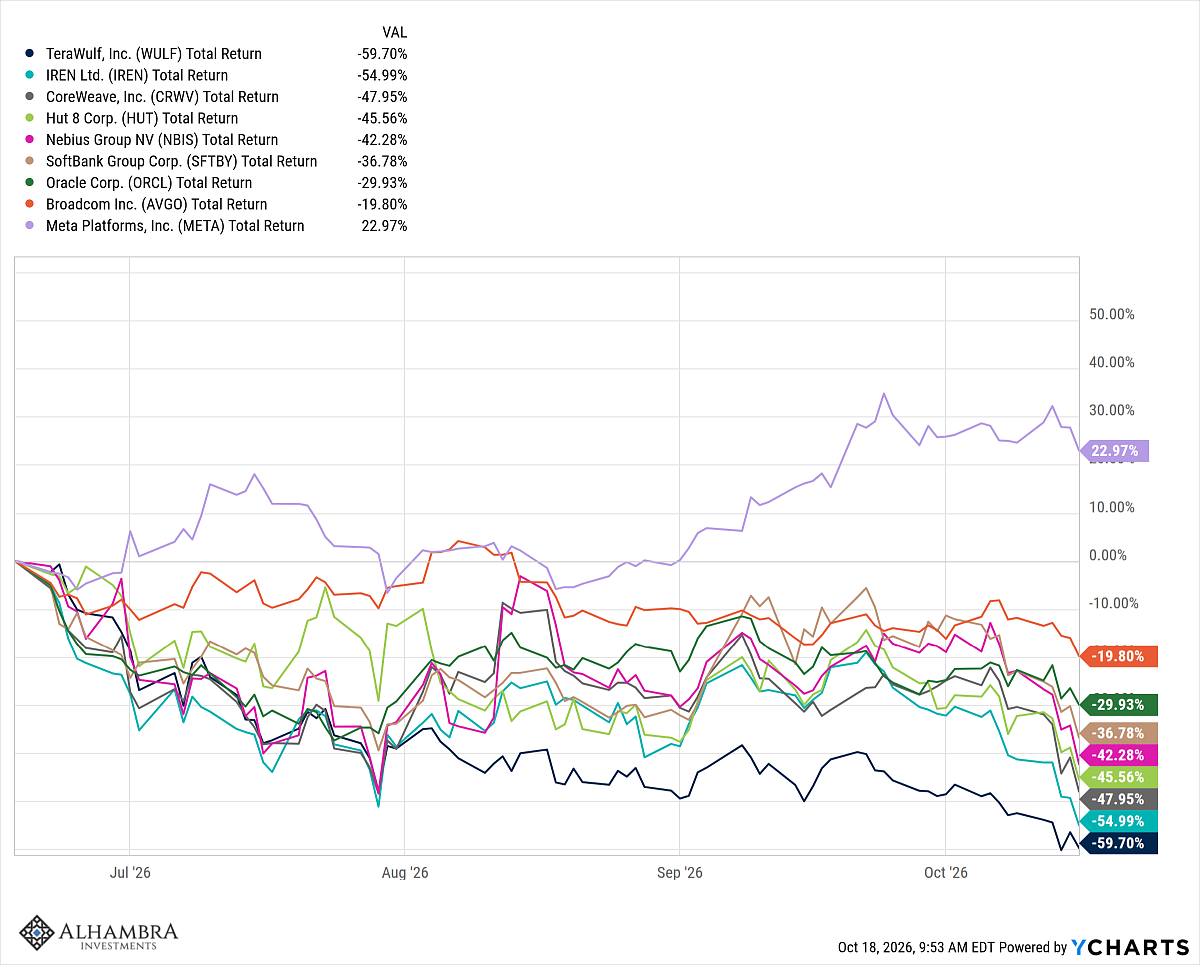
To be fair I should point out that the broader market (S&P 500) had a down week but less than 2%. Of the top ten names in the index, which comprise nearly 40% of the index, 8 were down. The two that were up – Apple and Eli Lilly – are also the only names not betting the farm on AI. In any case, the technology sector was an obvious drag but other areas of the market mostly made up for those losses. 7 of the 11 sectors in the S&P 500 finished higher on the week, although three of the five best performing are considered defensive: Consumer Staples, Utilities, and Healthcare.
One of the triggers for last week’s AI selling was Anthropic’s investor day with institutional investors. While we don’t have a transcript because they don’t let the hoi polloi in on these little confabs, we did get information from some who were in the meeting. The headlines look pretty good at first glance with revenue up 45% from Q2 to Q3, “adjusted” earnings profitable for the second straight quarter (no word on what was “adjusted”) and cash flow positive. Despite all that, expectations were for even more. Q1 to Q2 revenue gain was 147% so a 45% gain looks rather paltry by comparison. Expectations for a $100 billion annual run rate by the end of the year have been slashed to $75 billion. It is still a rapidly growing company that may or may not be profitable (almost certainly not on a GAAP basis) and is generating cash but rapidly growing isn’t enough with the high expectations that come with a technology we’ve been told repeatedly will change the world.
OpenAI has also missed expectations, posting a $50 billion annual revenue run rate in September against expectations of $68 billion. More generally, the chatter among the AI cognscenti is that a lot of the AI buildout now looks unprofitable, a conclusion we came to many months ago. Gartner, the well-known tech research firm, released a report last week titled, “Prepare for AI Market Consolidation: Capital Write-Downs Could Exceed $4 Trillion by 2032”. Their key points:
- Spending: AI providers spend nearly $1 trillion on infrastructure in 2026 and about $6 trillion more over 2027–2030.
- Impairment risk: more than $3.5 trillion of that spending could be exposed to impairment by the end of 2030, and more than $4 trillion through 2032.
- The revenue gap: data center operators would need about $8.5 trillion of cumulative revenue by 2030 to cover capex, financing costs and a 12% return on investment. Gartner projects at most about $3.6 trillion, a gap of roughly $4.9 trillion by my non-AI assisted math.
- Why: AI-optimized IaaS spending only grows from $66 billion in 2027 to $174 billion in 2030, which analyst Will Sommer says is too low for most compute providers to recover their investment before the current generation of chips is replaced.
- Who earns the revenue: because most AI-native providers are asset-light, less than half of AI revenue goes to companies that own significant infrastructure.
- Neoclouds: over 80% will cease independent operations by 2030 due to cost pressure and a lack of a differentiated business model. Hyperscalers are expected to weather it better thanks to diversified revenue.
It sounds quite negative but despite that, I wouldn’t count Gartner as an AI skeptic. And neither am I for that matter. My concern with AI has always been about the timeline, how long it takes before we realize the potential of AI. And today that looks like a lot longer than it did six months ago. The timeline – and falling compute prices – is why the neocloud stocks got hit first and hardest. But frankly, I still think growth expectations for AI are too high. Anthropic is trying to sell its IPO – which is why they had the investor day presentation – and is touting $200 billion in revenue by 2028 but to get there they will have to grow revenue 15% quarter to quarter for two years. The number of companies who have pulled that off in my memory doesn’t take a full hand of fingers: Nvidia (2023-2025), Google (2003-2006), Facebook (2009-2011) and Coreweave (2023-2026). Of course, two of those are from this AI boom but Google and Facebook have been great investments even after their growth rate fell. So, consistent growth at that high rate is not impossible but it is rare and far from assured.
Frankly, the idea that AI was going to generate enough revenue to be profitable for the data center operators was always ridiculous on its face. Getting a 10% return on investment for the total dollar spend on the AI buildout, using past known spend + an average of the high and low estimates out to 2031, a generous margin of 55% and asset life of 6-10 years, would require $2 – $3 trillion in annual revenue spent on AI which is about 1.5% – 2% of world GDP. That’s roughly the total of global wireless telecom spending or auto manufacturing or general insurance. That’s every year over the next five years. Where did everyone think that money was going to come from? If companies are spending that much on AI, they are going to have to spend less on something else; consumers spending $20/month isn’t going to get us there.
The money would have to come from labor or other IT spending or advertising or corporate profit margins or dividends or stock buybacks. Getting that from the labor force would be about 3% – 4% of global pay (and probably a higher percentage in the US). Do you think that might create some macroeconomic headwinds? Of course, the 10% return doesn’t have to come by 2030 or 2031 for the spend to be profitable but this back of the envelope calculation doesn’t include investing in new chips that will certainly be developed over the next decade. This isn’t the railroad or electricity boom where asset life is measured in decades. I don’t mean to imply that AI will not eventually generate trillions in revenue. If it even comes close to fulfilling its promise, it almost certainly will. But over the next 5 years? Doubtful.
I think we need to step back and look at a wider view to see how AI is affecting the market. The AI stocks are not the only ones that have suffered recently; other areas of rampant speculation have also cooled. For leveraged speculators, a blow up in one speculative sector often begets selling in other speculative areas. Take a look at the space stocks that were all the rage right up until SpaceX went public. AST Spacemobile peaked at nearly $134 in late May and currently trades for about $40. Rocket Lab, down from $151 to $51; Planet Labs, $51 to $13.5; Intuitive Machines, $46 to $11; SpaceX itself down from its peak of $225 to $146. This speculative phase, like all the ones we’ve seen over the last five years, is either over or nearly so.
I think we also need to pay close attention to the credit markets going forward. At first, most of the AI buildout was coming from the existing cash flow of the big tech companies like Alphabet, Microsoft, etc. But as often happens in booms, the more recent buildout has been done with debt. And the market is already starting to price winners and losers; the neocloud stocks may just be the tip of the iceberg. If AI debt continues to get marked down, it will affect lending in areas that have nothing to do with AI. We’re already seeing credit spreads move wider, across all the HY tiers. Interestingly, investment grade spreads have barely budged and there is a lot of AI exposure there. We’re getting a general repricing of risk in credit markets but it hasn’t spread to investment grade…yet.
As for the stock market as a whole, prices are driven by earnings which have been growing rapidly, mostly due to the AI buildout. We are currently in Q3 reporting season and earnings are expected to rise by 29% over last year (Factset). Next year, growth is expected to fall to about 15% with about 80% of that expected to come from the tech sector and the majority of that expected to come from the semiconductor industry, which is on the front end of AI spending. If AI slows down, semiconductor company earnings are going to be…affected. There’s a reason chip companies are considered cyclical. These stocks are leading the earnings parade now; earnings growth for the S&P 500 this quarter would be 20% instead of 29% if you exclude just two stocks – Nvidia and Micron. Both have considerable – and growing – competition and if the AI slowdown continues, pricing will fall, particularly for Micron and the rest of the memory chip stocks.
Furthermore, a large chunk of recent earnings growth has come from companies marking up the value of their investments in AI companies, like Anthropic and OpenAI, which aren’t public yet. The private investment markups at just two companies – Google and Amazon – pushed S&P 500 earnings up last quarter by $151 billion. OpenAI has already pushed their IPO to sometime in 2027 and Anthropic, which was initially pushing their IPO at a $2 trillion valuation, is now talking about $1 trillion. The markups last quarter were likely based on the most recent funding round for Anthropic that valued the company at $965 billion; it seems unlikely that these holdings will be marked up again this quarter. And, oh by the way, a big part of the markup in Google’s earnings was likely from SpaceX, in which they also hold a significant position. If SpaceX stock falls from last quarter’s mark, Google could have to book a loss.
This probably isn’t the end of the AI boom but it appears to be the end of the most speculative phase. The market had priced the AI stocks as if trillions of dollars of new revenue were a certainty but that now looks like a pipe dream. Reality bites.
Joe Calhoun

Stay In Touch