

A Glimpse of the Future?
I was reading through some blog posts this morning and ran across one titled ‘The Stock Market Does Not Equal The Economy”. I’ve heard this phrase numerous times in my career, usually the elongated version: “The stock market is not the economy and the economy is not the stock market.” It is an odd thing to say since much of what gets written about the stock market – and other markets – is actually about the economy. A discussion about interest rates is absolutely a discussion about the economy. A discussion about future earnings is very much a discussion about the economy. Whatever market is the topic of discussion, from commodities to currencies, it is always about the (global) economy. While it is true that the economy and markets are not correlated in the short term – are indeed negatively correlated at times – they are tied at the hip over the long term.
I will certainly admit to using this phrase in the past but I have always tried to draw a distinction. The stock market is certainly not about the current economy. And to be even more accurate, the stock market is not about yesterday’s economy. All the hard economic data we get is about things that have already happened and the stock market only rarely cares about the past. There are times when economic data about the past is so surprising that it changes the stock market today but only if that data also impacts the market’s view of the future. An investor might be able to glean some tidbit of information about the future by parsing the past data, but the market, the crowd, will almost always beat you to it.
Stock prices are determined, like any other price, by supply and demand. Buyers and sellers continually debate what stocks are worth; that’s what makes a market. If we’re talking about one company, the debate might be about metrics that are specific to that company, like their competitive position relative to others in the same business. But if we’re talking about the market of all stocks (or some broad subset like the S&P 500), the discussion turns to earnings expectations, interest rates, and risk premiums (which reflect fundamental risks and investors willingness to bear them, i.e. sentiment). All of those things are a function of the future economy. Over the long term, corporate earnings grow at the rate of Nominal GDP (real growth + inflation). Nominal interest rates reflect expectations for future NGDP growth while real rates reflect expectations about real growth; the difference between the two reflects expectations about future inflation. Interest rates in turn affect stock market valuations through the discount mechanism. In general, higher rates push down valuations while lower rates raise them.
That is somewhat simplified but adding complexity doesn’t change the fact that market prices today reflect the future economy or, to be more accurate, expectations about the future economy. Long-term interest rates, such as the 10-year Treasury note yield, aren’t only about future NGDP growth; they also reflect a term premium. Term premium is the extra yield demanded by the market for tying up cash for a longer period of time; a lot can happen in 10 years. If we’re talking about the term premium in Treasuries, it will reflect fears about things like fiscal sustainability, which will obviously impact the future economy. Assuming nothing else changes, a change in term premium will affect interest rates and stock prices today.
There are some economic reports that provide limited information about the future. Surveys, like the ISM and regional Fed surveys, include information about orders which can turn into future economic activity. Core capital goods orders and shipments can provide insight about future investment and growth. Building permits can provide advance notice of changing housing activity. Initial jobless claims are an early indicator of economic stress. However, orders can be cancelled, all capital investment doesn’t pay off, and it costs nothing to pull a permit.
Most forward-looking indicators, though, are market based. The yield curve has a pretty good track record of predicting future economic growth. A flatter curve, where the difference between long term and short term rates is narrow, is associated with slower future growth. A steeper curve is associated with higher future growth. The reasoning is simple but not always accurate. A flatter curve is generally a less profitable lending environment for banks so they lend less which limits growth. The only problem with the theory is that it is hard to find in the lending data. Nonetheless, it has been generally true that future growth is reflected by the shape of the yield curve – and how it is changing – today.
Credit spreads – the yield spread between a risky bond and a risk-free bond – are a good indicator of future activity but are really just a measure of sentiment. Wider spreads signal a falling appetite for risk and less risk taking can mean lower future growth and weaker corporate earnings.
Markets are not, however, infallible. In a 1966 Newsweek column, Paul Samuelson, said “the stock market has predicted nine of the last five recessions” and it is true that stock market investors tend to be a jumpy bunch. Bond investors are more sober but their views of the future economy can also be wrong and require investors to make rapid adjustments. Still, absent the existence of a working crystal ball, markets offer the best view of the future you’re likely to get.
Market Indicators
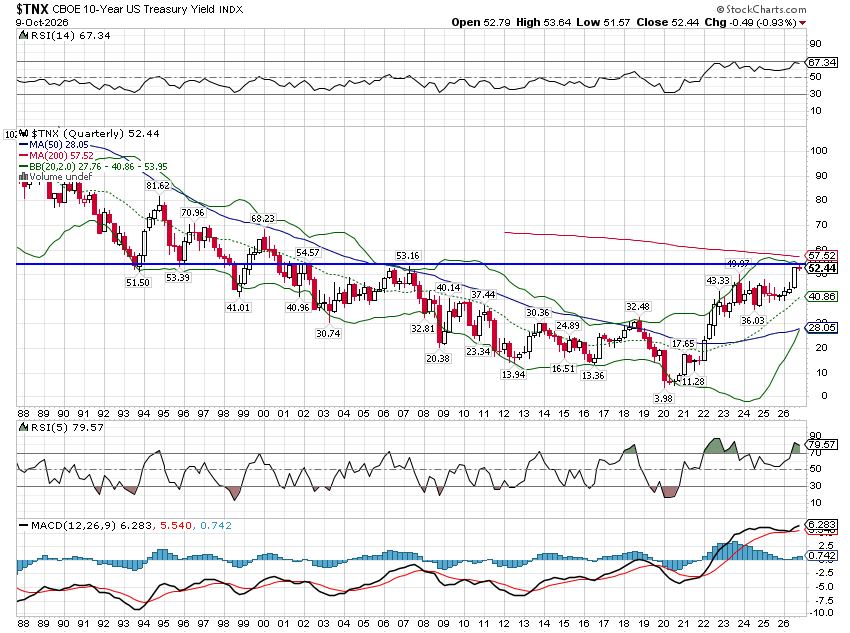
The 10-year Treasury yield did finally break out of its 3-year trading range but it is now bumping up against long-term resistance, so a pause in the rising rates scenario may be upon us. But, with YoY NGDP growth of 6.3% and the 10-year over 100 basis points lower, there is ample room for further rises. It would likely take a change in the outlook for AI to reduce growth expectations and interest rates. While we’ve seen some indications of that it hasn’t been enough yet to change expectations.
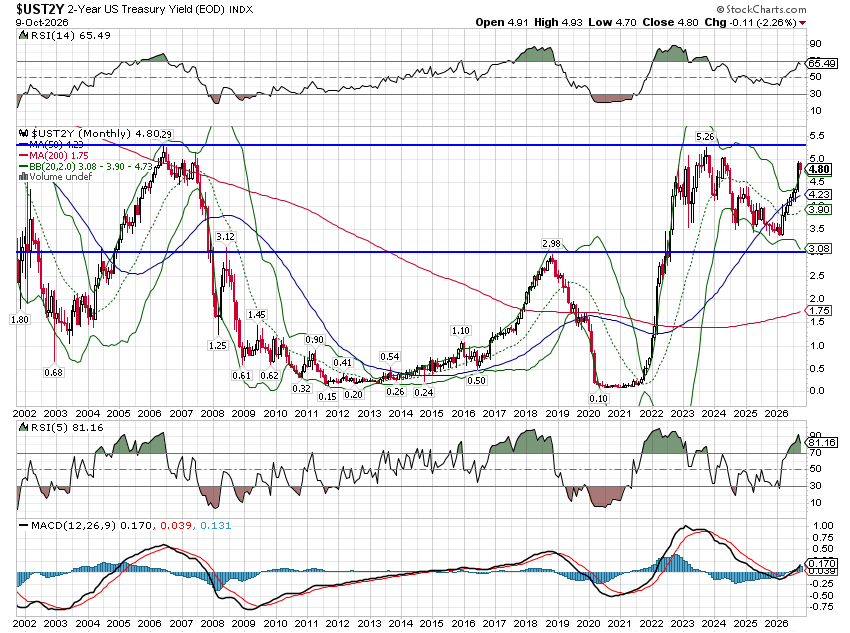
Short-term interest rates also appear to be near a peak and reflect waning expectations for further Fed rate hikes. Right now the SOFR futures market is pricing a pause at the November meeting and a 1/4 point hike at the December meeting (71.6% probability) but no meeting next year shows more than a 50/50 chance of another hike.
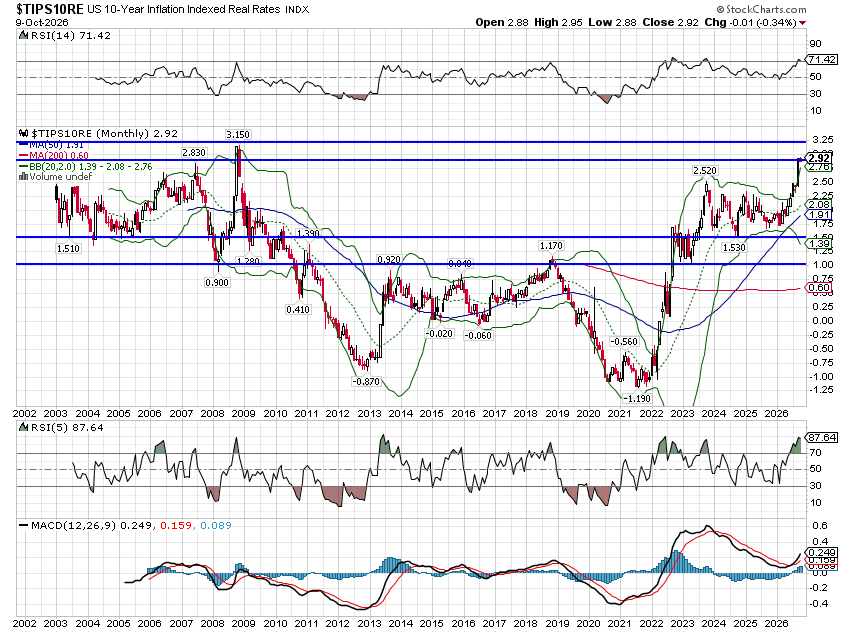
Real rates (10-year TIPS) are near a 20-year high but there is limited history with TIPS. Real rates have been higher in the past so no one should take this as a ceiling. This rise in real rates is confirmation that the run up in nominal rates was not about inflation worries. So far, the market seems to believe current inflation is temporary. One can’t help but wonder what it would take to dislodge those expectations of tame future inflation. 10-year inflation expectations, as measured via the TIPS market, are still just 2.33%.
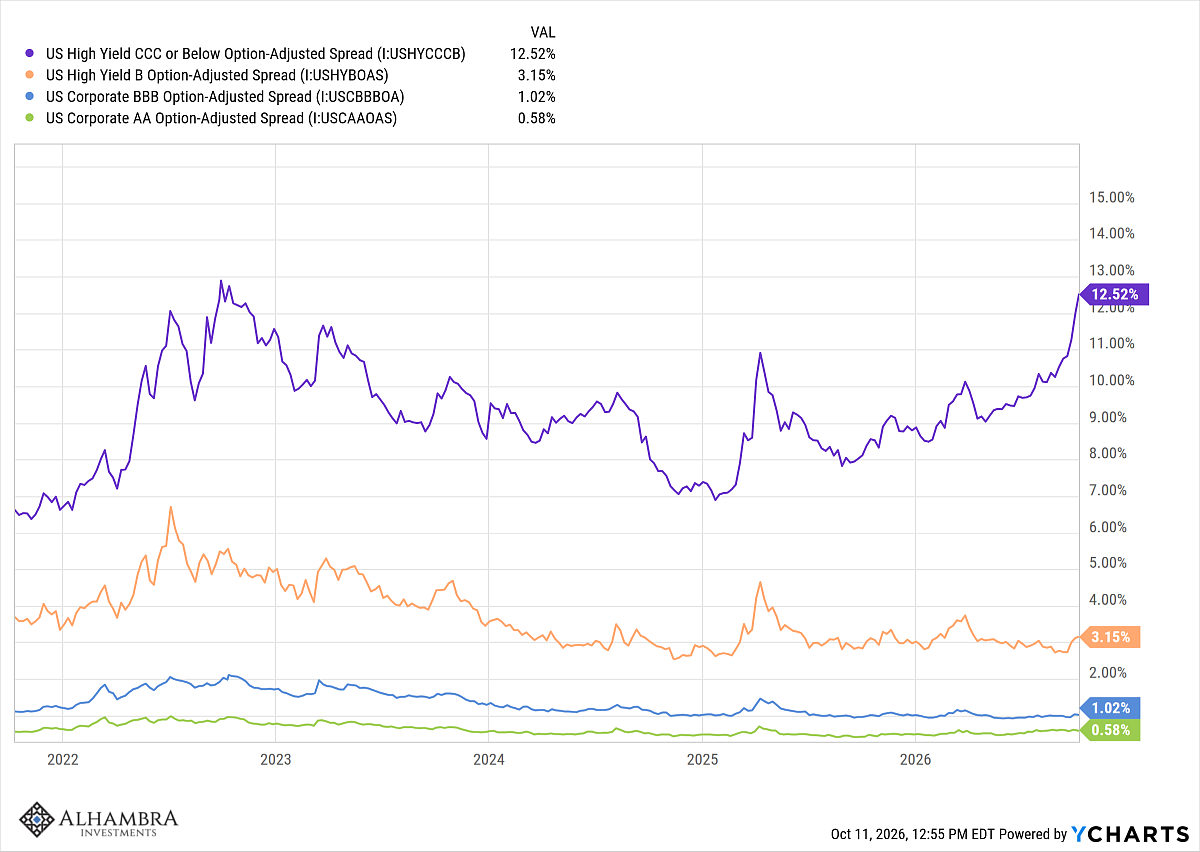
Credit spreads may be offering a warning about future growth. The rise in investment grade spreads has been negligible and even highly rated junk hasn’t moved much. But the junkiest end of the market has seen a more rapid and significant widening. For comparison purposes, CCC spreads are currently a tad wider than they were in the spring of 2008. No, I’m not predicting anything and a quick glance at the chart shows the spread was slightly wider in 2022 and no recession followed. But it does provide some perspective about how quickly things can deteriorate. In 2008, the CCC spread doubled between March and October.
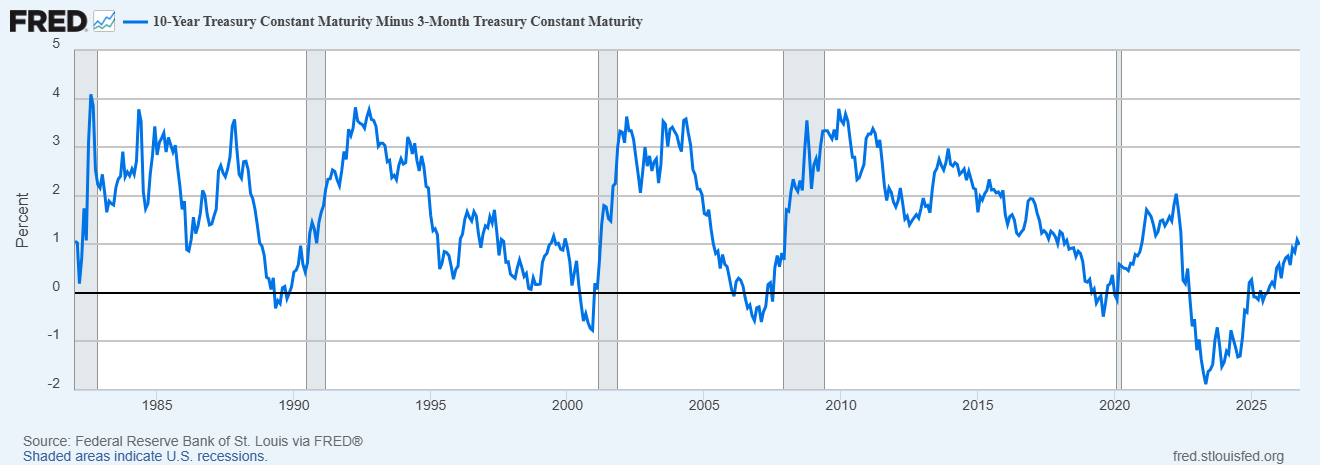
For term spreads (yield curves), I generally watch the 10-year/3-month spread as it has, in the past, provided the best fit for forward GDP growth. That spread has been steepening recently, confirming the rise in growth expectations we see in the bond markets. The Cleveland Fed uses a model of the slope of the 10-year/3-month spread to predict GDP growth one year ahead and that is currently showing expectations of 3.5% real growth. That seems optimistic to me but the market says otherwise.
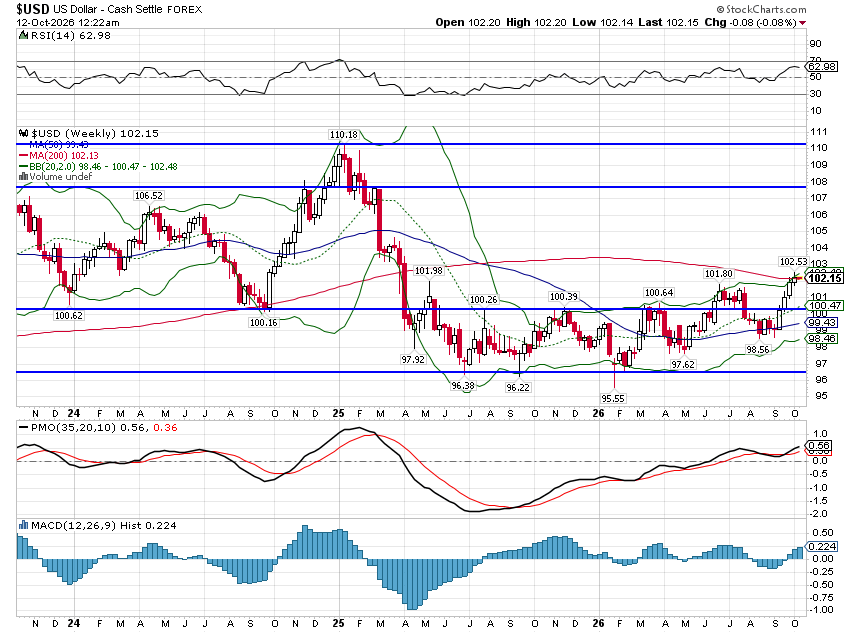
The dollar has been firm lately, an indication that US prospects are perceived as better than the rest of the world. Given the weightings of the dollar index, the most recent move is mostly about the Eurozone. I would venture to say that France’s alleged fiscal difficulties are part of the problem. I would just point out that France bond yields are lower than the US and our debt/GDP ratios and annual deficits are about the same. Real yields have also been rising in France but rates are lower than the US. This most recent rise in French rates looks more tied to energy inflation and maybe ECB rate hike fears, than fiscal worries. Core inflation, by the way, was just 1.1% in August while headline was 3.0% so this is really about energy.
Whatever the cause of Euro weakness, the dollar has been firm because the US economy has been firmer than the rest of the world.
Selected Economic Data
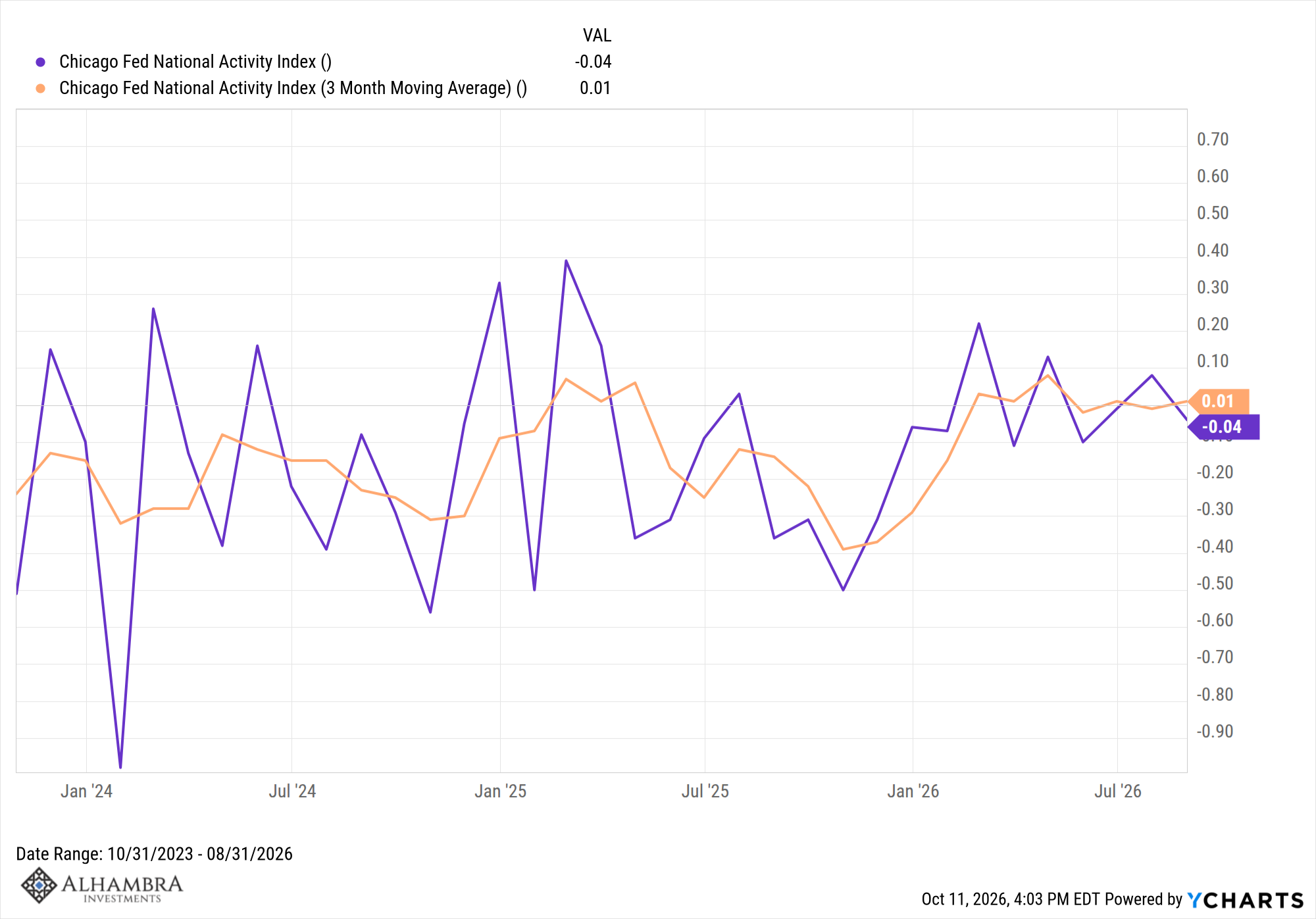
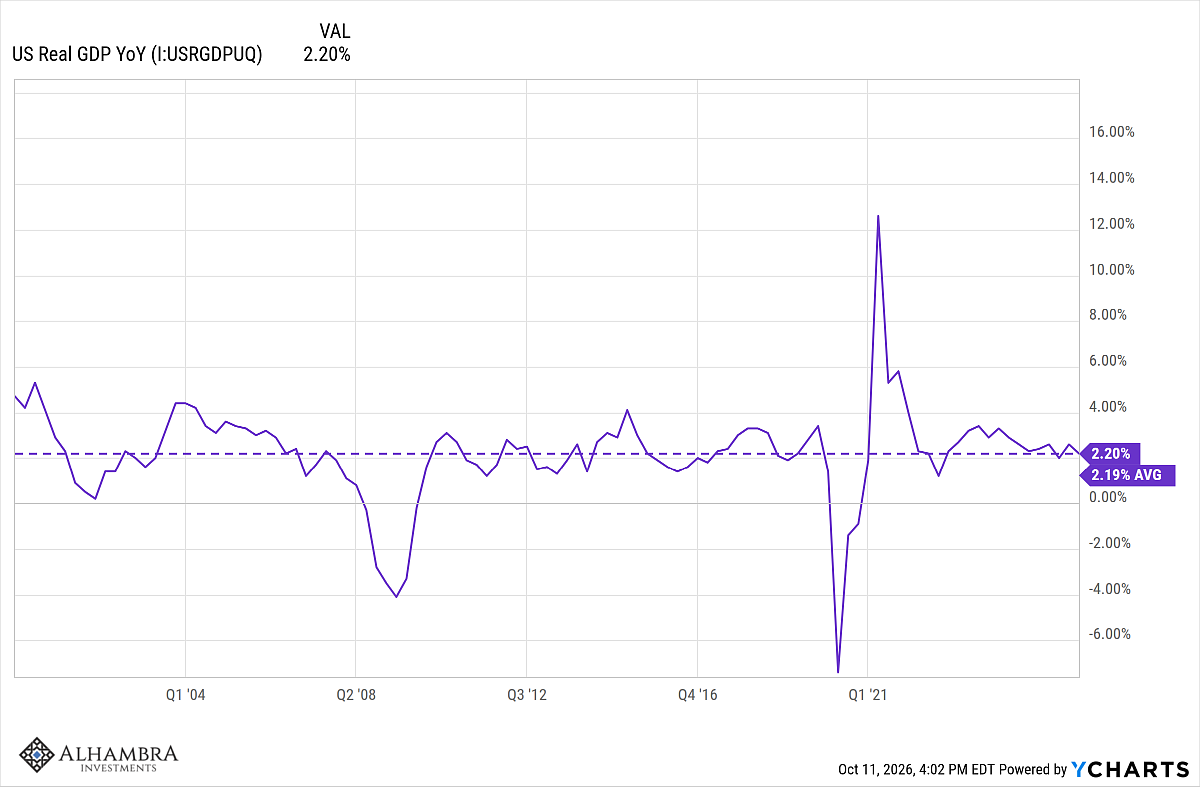
The Chicago Fed National Activity index is a broad measure of the current economy. A reading above zero indicates growth above trend and a negative reading indicates growth below trend. It is currently at 0.01, which means trend growth. What is trend? The average YoY change in real GDP since 2000 is 2.19%. The YoY change right now is…2.2%. I don’t know about you but given all the hype over AI, I would have expected growth to be better. Maybe it will raise growth in the future but despite trillions of dollars in capital spending, it isn’t right now.
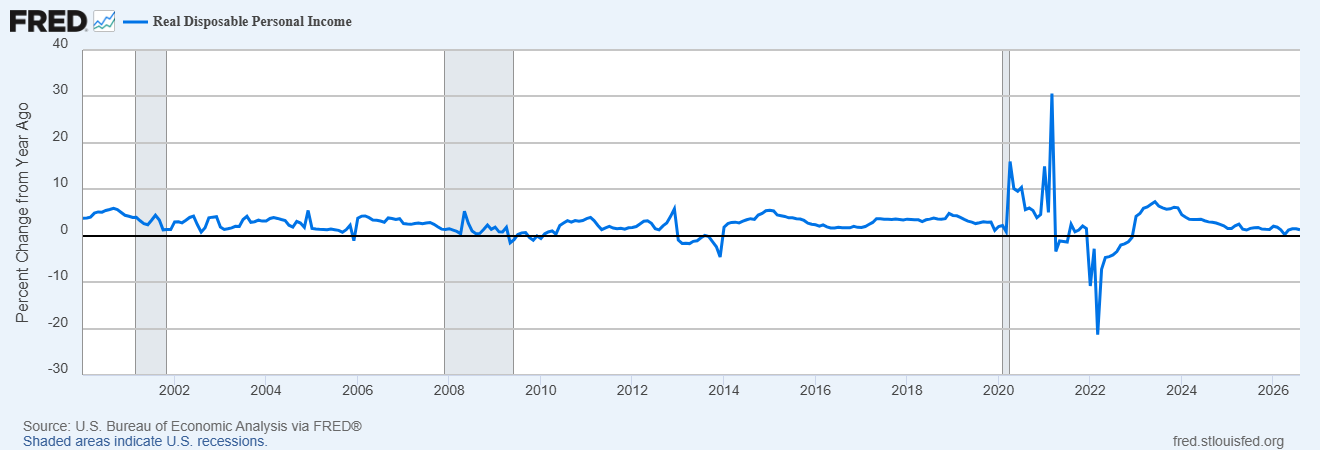
The year-over-year change in real disposable personal income (after tax, adjusted for inflation) is down to just 1.3% versus the long-term average of 2.5%. So far, slowing income growth has not significantly affected consumption as the savings rate has dropped to compensate.
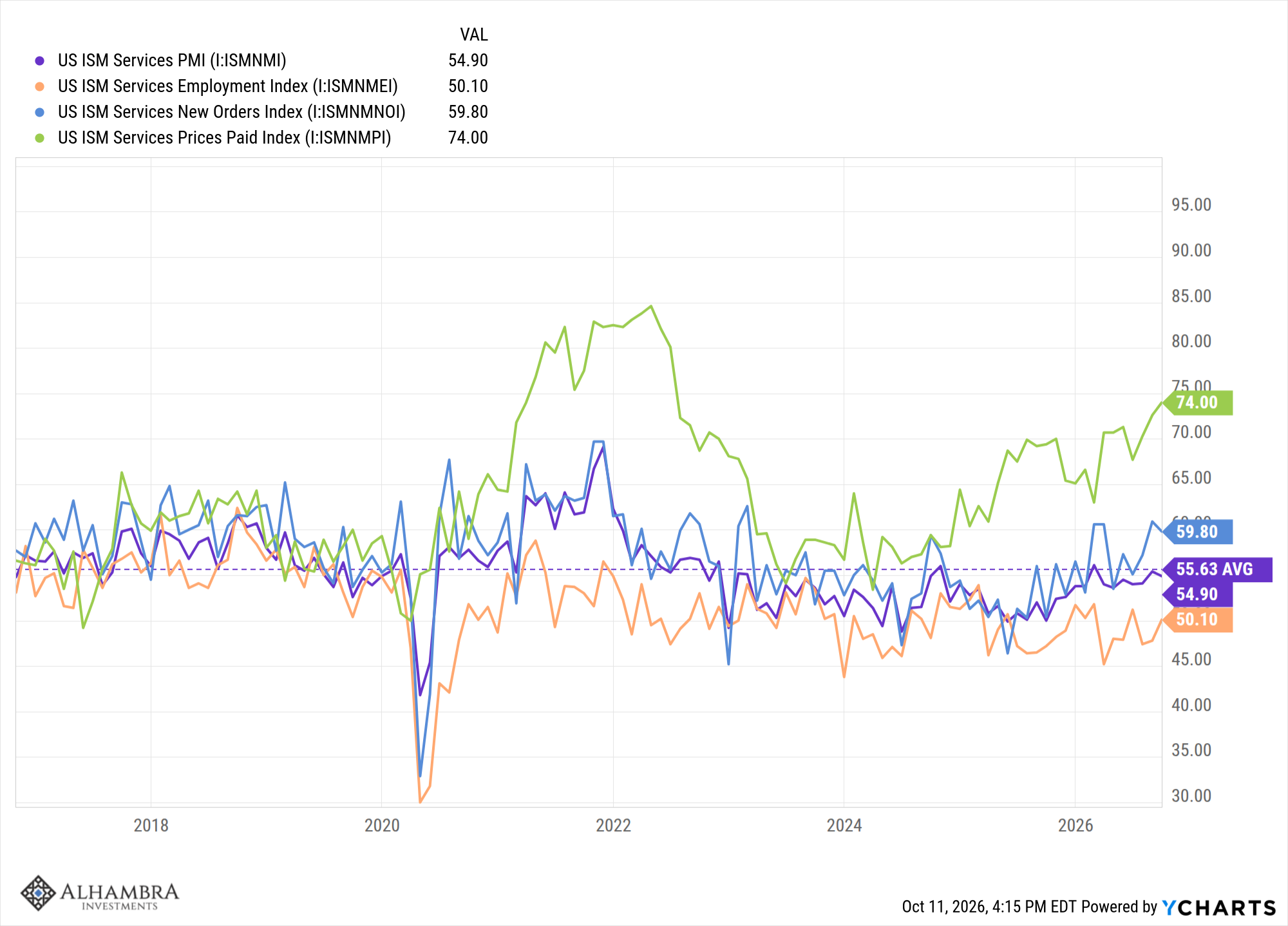
The ISM surveys continue to show positive growth. New orders are strong in both services and manufacturing. Unfortunately, prices are rising rapidly too.
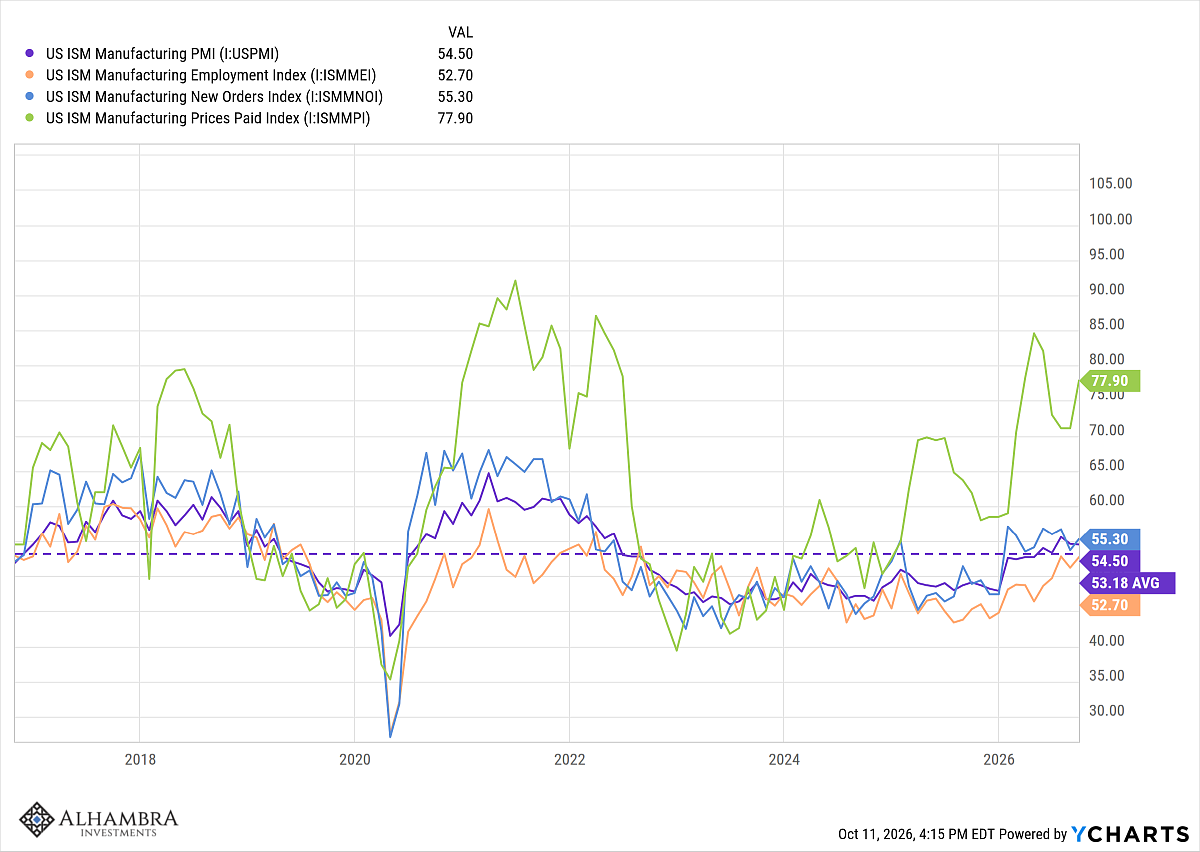
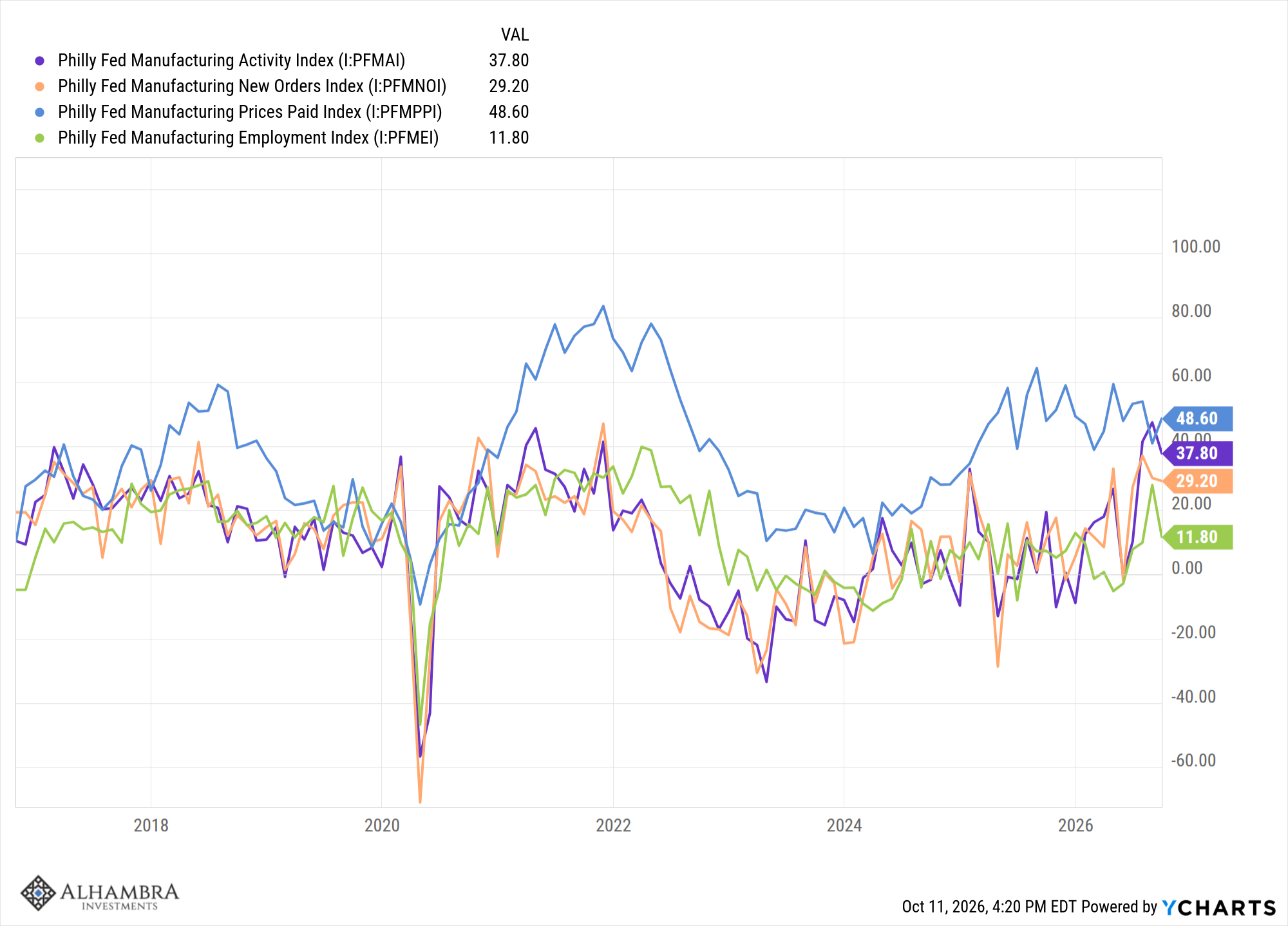
The regional Fed surveys may have peaked. Results for September show a drop from August in every region except KC. Most of them are still positive (Dallas and Richmond have turned negative). As with the ISM surveys, prices paid is still elevated.
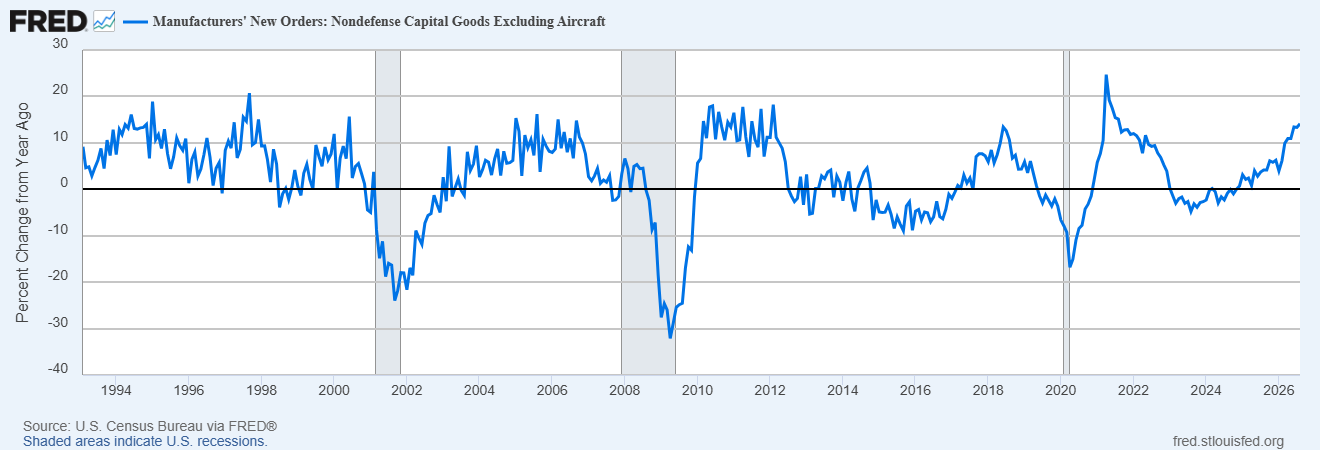
Durable goods orders have been good and capital goods orders in particular. Non-defense capital goods ex-aircraft (core capital goods) orders are up 14.1% over the last year.
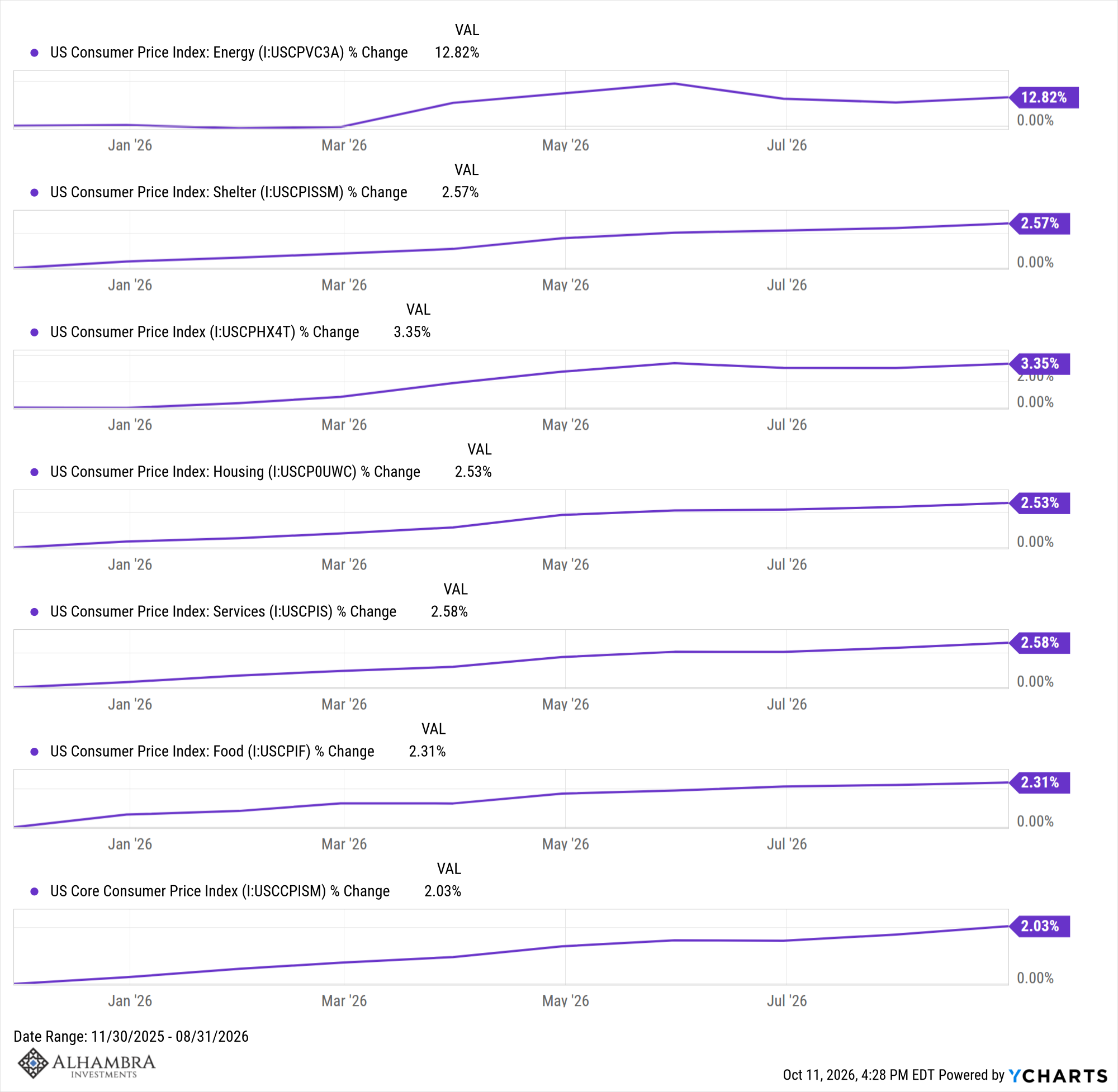
Inflation is still too high but outside of energy it seems pretty well contained. The question I guess is how long it takes to recover from the Iran mess. Just my opinion, but it doesn’t look like something that will be quick. Still, if inflation stays between 2 and 4%, history says stocks can weather that.
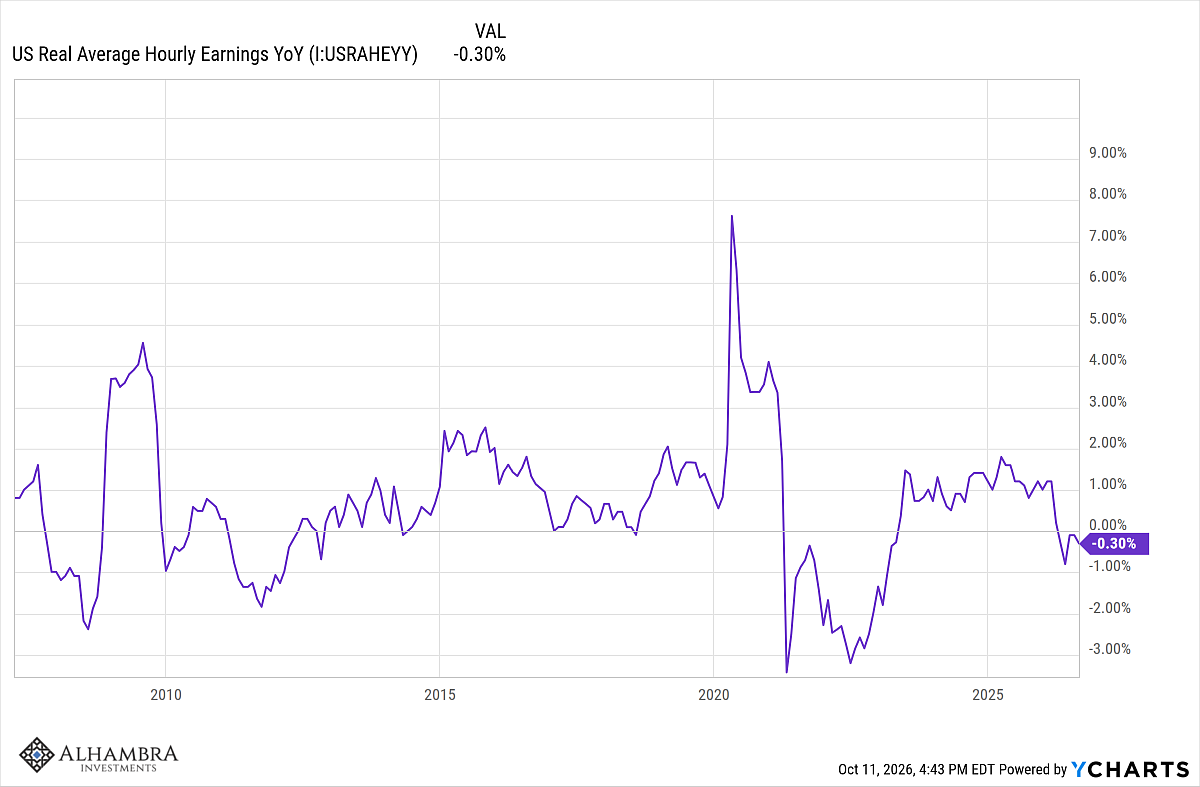
Employment remains strong even if the monthly add of new jobs is historically weak. With almost no immigration, the monthly figures aren’t going to move as much as they have in the past. One disappointment is real average hourly earnings which have fallen 0.3% over the last year.
Summary
The current economy is growing at trend with inflation still elevated due to higher energy prices. Market-based indicators continue to point to an acceleration in growth over the next year. Whether that is accurate will likely depend on the course of the AI buildout. If the AI buildout starts to slow, growth expectations and interest rates will fall. The evidence of such a slowdown is currently lacking but I don’t think it is realistic to expect capital spending to continue to expand at the current rate. For now, though, I don’t think a slowdown can be predicted with a high degree of confidence; certainly the market is not anticipating it.
Credit spreads do offer a warning but not a strong one at this point. It is, so far, only the junkiest credits seeing widening spreads.
Real income growth is also weak and a potential warning but in the short term, that may have more of an impact on the election than the economy or markets. Household debt as a percentage of GDP is the lowest its been in 25 years and household debt payments as a percent of disposable personal income is only a little over 11% which is about the average since 1980 and way lower than the peak in 2007 over 13%. The consumer isn’t happy (see consumer sentiment) but that hasn’t stopped them from spending.
With economic expectations high that also means earnings expectations are high. We’re just entering earnings reporting season so we’ll see how things come out. More important than last quarter’s numbers will be management commentary about the future. With expectations this high, they better be good.
Joe Calhoun

Stay In Touch