

It seems like a lot has happened over the last few weeks. At the end of July, Treasury Secretary Bessent used the exchange stabilization fund to purchase Yen by selling Euros. That intervention was intended, according to the accepted wisdom, to prevent the Japanese from selling US Treasuries to fund purchases of the Yen themselves. The Japanese are large holders of US Treasuries and the fear is that if the Yen falls in a disorderly fashion, they will be forced to sell their Treasuries to support their currency. That is true in a technical sense but it misses something – the Japanese have already sold some of their Treasuries. It isn’t a lot in the scheme of things but we know they’ve sold about $30 billion in Treasuries already this year. Still, if the Yen keeps falling, they may need to sell more and Bessent’s job is to find buyers for our ever expanding pool of US debt; if Japan is a bigger seller, other, more price-sensitive buyers will have to step in.
Further evidence of this fear of a lack of Treasury buyers emerged last week with Bessent announcing a change in the Treasury’s buyback plans. The Treasury routinely makes offers to buy back long-dated, off-the-run Treasury notes and bonds. Off the run just means it’s a bond that was issued some time ago and isn’t the benchmark bond anymore. A 10-year sold two years ago is now an 8 year bond without much demand. Sellers get liquidity from this Treasury program to sell these off-the-run issues. Bessent’s announcement last week that these off-the-run buybacks would double in size was taken by many as an indication that he is trying to control long-term interest rates. Long-term rates fell when the change was announced but that didn’t last and by the end of the week, rates were higher than when the announcement was made. And no wonder; the buybacks are in $4 billion tranches and we’re running such large deficits that we need to issue $10 billion in net new issuance every day to fund them.
These two actions have generated a lot of press over the last three weeks, much of it framed as fear of a potential US debt crisis. I suppose that’s possible but it isn’t as if investors are abandoning US assets; the dollar is down a little but has been pretty stable this year. Furthermore, if there is a loss of demand for Treasuries, that wound has been largely self-inflicted. We have imposed tariffs – or soon will – on basically the whole world. Standard trade theory says that the currency of a country on which tariffs have been imposed will fall to offset the cost of the tax. A weaker currency is inflationary so these countries often support their currencies by, you guessed it, selling some of their holdings of US Treasuries. Japan, China, India, and Brazil have all sold Treasuries recently.
The administration has also “encouraged” other countries to invest in plant and equipment in the US. Well, doing so requires dollars, dollars that would have gone to Treasuries but now must go to physical goods. Now, there hasn’t been a lot of that yet but there has been some and that also affects demand for Treasuries at the margin. Finally, there is the matter of the massive borrowing to fund the AI build out. The bond market has had to absorb about $500 billion in new corporate debt already this year and adding in new issuance from Treasury and other sources, the total gets up to almost $2 trillion. Total will likely come to at least $3 trillion in new borrowing this year and a similar amount next year, assuming the AI boom continues.
And a lot of this new debt is on the long end of the curve; Alphabet issued a 100-year bond earlier this year and has sold other issues with 30-year maturities. Meta has issued at least one bond with a 40-year maturity and Microsoft and Amazon have also issued 30-year paper. It may not be a crisis but there is a lot of competition for investment dollars at the long end of the curve and I suspect a lot of institutional investors see Alphabet, Microsoft, and Amazon as better credit risks than the US government.
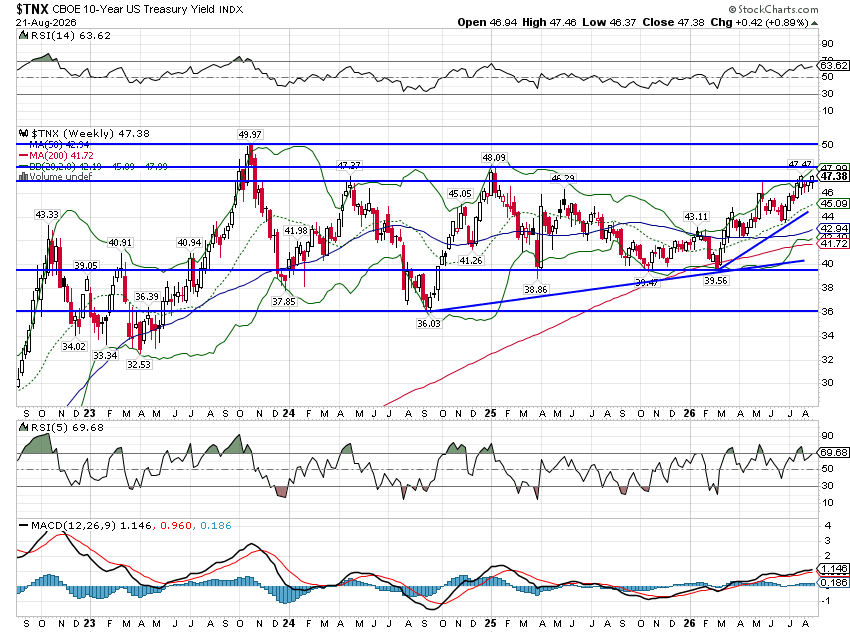
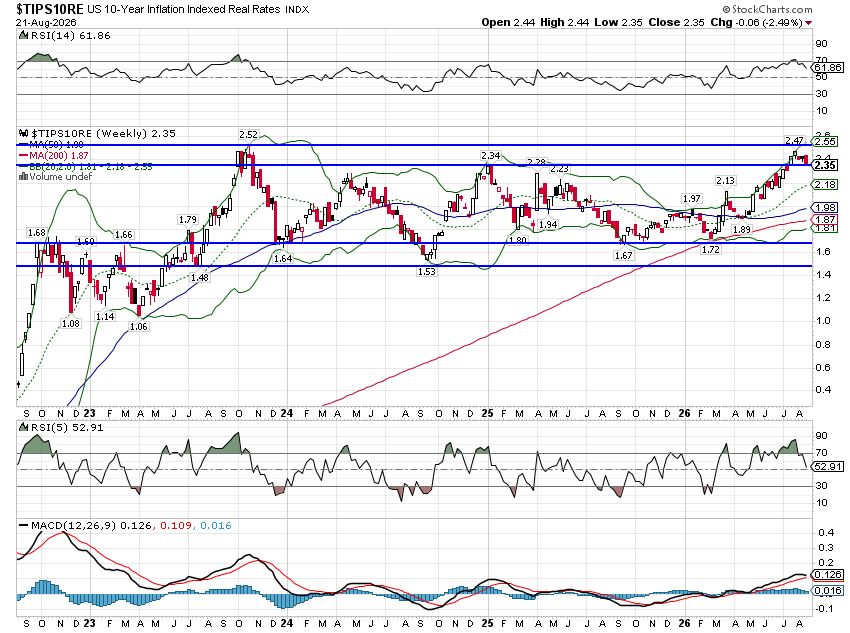
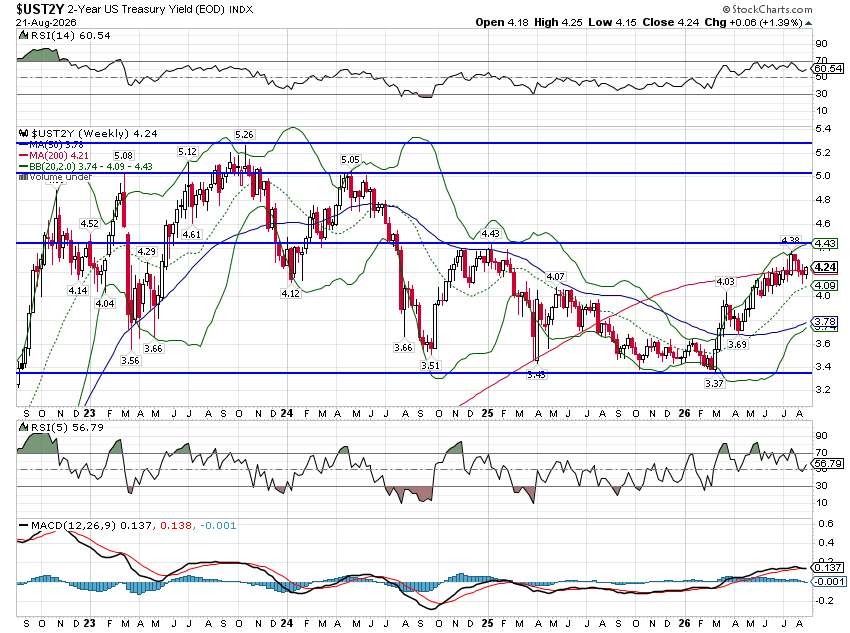
I have been writing for a long time about how the current state of the economy hasn’t really changed that much. I say that because interest rates have been trading in a range for several years now and despite everything that has happened over that time, rates remain range bound. And after all the drama of the last few weeks, that is still the case. Yes, rates are near the high end of that range but they haven’t broken out yet. Maybe they will soon and we can say that growth and/or inflation expectations have shifted to a new level, outside where they’ve been for the last 3-4 years. But not yet.
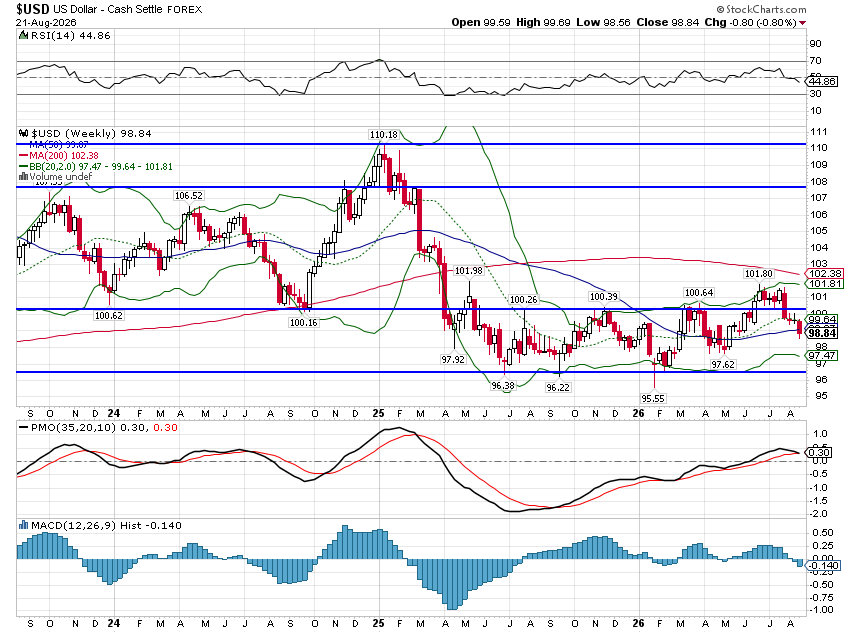
The dollar also hasn’t moved much:
There are, however, reasons to expect rates to continue rising. The economic data recently, with the exception of a weak retail sales report last week, have been pretty solid. And the biggest drop in retail sales in July was in online sales (-2.2%) which was a direct result of Amazon shifting Prime Day to June; you need to average June and July to get a more accurate view. Manufacturing data has been trending in a positive direction for months with the ISM manufacturing PMI now over 55. The regional Fed surveys are all positive with the Empire State and Philly versions particularly strong. Heavy truck sales, one of my favorite indicators, have rebounded nicely. Durable goods orders ex-transportation have been strong and core capital goods orders have as well.
This doesn’t have anything to do with tariffs by the way, at least not in a positive way. Inventories relative sales are at multi-year lows as companies have tried to game the on again/off again nature of trade policy. Inventories are lean at the wholesale and retail level which is exactly what you would expect given the volatility of trade policy. But they’re at a point now where some restocking has to happen unless sales suddenly fall off a cliff, something we haven’t seen; Redbook same store sales are up nearly 9% year-over-year. Don’t take this for an all clear that the economy is great because it isn’t, but Nominal GDP is up 6.5% year-over-year. Unfortunately, way too much of that 6.5% is inflation and right now the year-over-year change in the GDP deflator (how GDP is adjusted for inflation) is 4.4%. And here’s another surprise; the change from Q1 to Q2 annualized is 6.3%. Maybe there’s a good reason long-term rates aren’t falling.
Why is the deflator so much higher than the inflation numbers we’ve seen from CPI and PCE? Well, the deflator tracks the price level of everything that is produced domestically, whereas CPI and PCE track the price level of what is consumed. The GDP deflator also excludes imports because GDP measures domestic production. CPI and PCE only measure consumer spending where the GDP covers the entire economy. Another difference is that the deflator uses a chained weighting scheme that updates every quarter based on what is actually produced. Of course, this measure isn’t how the Fed looks at things and all of the price rises in the GDP deflator may not make it to consumer prices, but don’t you think it might give us an inkling about what may be coming?
That NGDP number is important to keep in mind because that is the magnet for rates. The 10-year Treasury yield has, over the long term, tracked the year-over-year change in NGDP pretty closely. With the 10-year currently trading at 4.74%, no one should be surprised that rates are still rising. The alternative is for NGDP growth to slow and that would be great if any drop came only out of the inflation side of that equation. That’s why so many FOMC members are pushing for a rate hike, to slow NGDP growth (or aggregate demand if you like that better). But monetary policy isn’t that refined and can’t target inflation by itself. Hiking rates will likely have an impact on real growth too, which is why the Trump administration is so opposed to it.
I have said many times that I don’t try to predict the future and that hasn’t changed. I focus on gaining as clear a picture of the present as I can by closely observing market prices. But figuring out what’s going on with the economy isn’t just a matter of observing market prices; you need to think about why market prices are changing. For example, falling oil prices driven by a new large oil deposit is an economic positive, while falling oil prices that result from a collapse in demand is a negative (probably); the cause matters. Investors should always be thinking about why things are changing, even if those changes are small and, as in this case, within a range that has existed for some time. There may be no change in expectations about the macro economy but the micro matters too.
And I must admit that the changes over the last few weeks do have me at least a little concerned. The commentary above is centered on interest rates but the more interesting developments, especially last week, were in currency and commodity markets. The dollar index was only down 0.8% last week but the moves that inspired were larger. Commodities (GSCI TR +4.6%) were up almost across the board: gold (+5.2%), silver (6.7%), platinum (7.6%), crude oil (5.1%), heating oil (4.1%), cotton ((4.1%), corn (5.3%), coffee (3.2%), gasoline (4.3%), soybeans (4.1%), sugar (6%), wheat (1.1%). Those are not small moves and while some of those can be attributed to the Iran war, much of the rest appears to be about dollar fears. This does not look like an economy that has tamed inflation.
When Bessent bought Yen a few weeks ago, he funded it by selling Euros and my guess is that he did that to make sure buying Yen wasn’t seen as an explicit desire for a weaker dollar. I’m not sure the market really cared though because the administration has made it pretty clear from the beginning that they prefer a cheaper dollar (to which I say be careful what you wish for). The actions taken last week on the bond buybacks may not have had a lasting impact on rates but I think it sent a signal too. History is filled with examples of countries with large debt loads resorting to some form of financial repression to inflate away the debt.
Capping long-term interest rates would be a perfect example of such repression and there is a US precedent (most recently 1942-1951). It appears there were enough believers in that scenario to move the dollar and commodities last week. Having said that, I should add that I believe our debt position is manageable but not indefinitely. Our national debt is less than 10% or our total assets of about $420 trillion (public and private) and about 22% of our national net worth of $180 trillion. That doesn’t mean I like having this much debt but it isn’t as onerous as it seems. If rates keep climbing that might change though; federal government interest costs are already at $1 trillion a year.
You shouldn’t take my concerns as an indication that I think we need to take immediate action in our portfolios. Interest rates and the dollar are still in those ranges they’ve been in for the last few years and until that changes, I think you have to expect it to stay that way. I would also point to sentiment that is very negative about both the Yen and Treasuries. There is a large short position in long-term Treasuries and Yen bulls* are scarce too. I would also add though that if the 10-year Treasury breaks decisively above the psychological threshold of 5%, rates may rise very rapidly; that appears to be the market’s line in the sand.
We can’t predict the future but that doesn’t mean we shouldn’t think about it. I think about the possibilities all the time and our portfolios are structured with multiple asset classes – not just stocks and bonds – so we can weather just about any storm. If I can’t know with any degree of certainty what the future holds – and no one can – then I need to be prepared for anything. That’s what a strategic allocation is all about – humility.
Joe Calhoun
*I hold a small long Yen position in my personal account.

Stay In Touch