

I know I’ve written about rates and bonds seemingly every week, but it’s been necessary. Last week, the 10-year yield finally broke above 5%, an event I’ve anticipated for years, rising nearly 19 basis points to close at 5.18%.
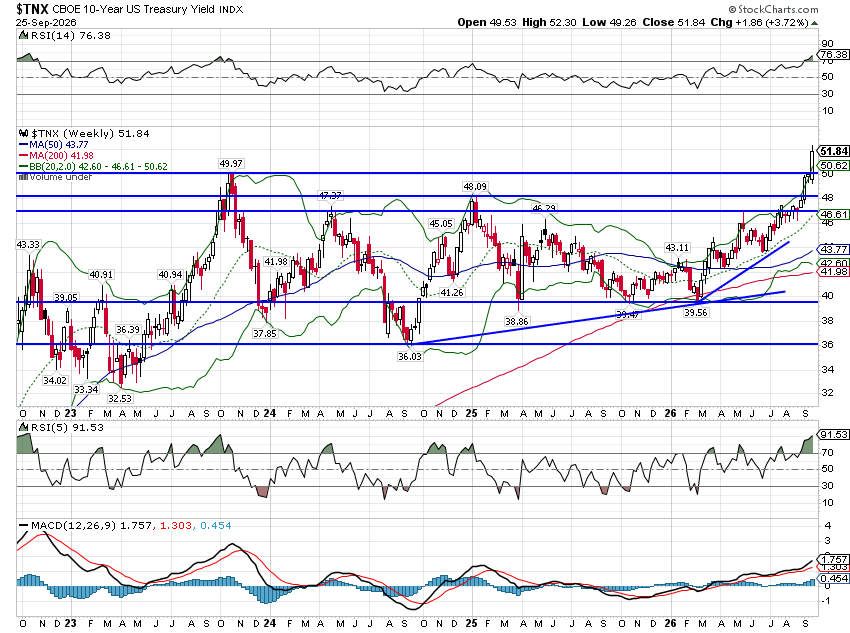
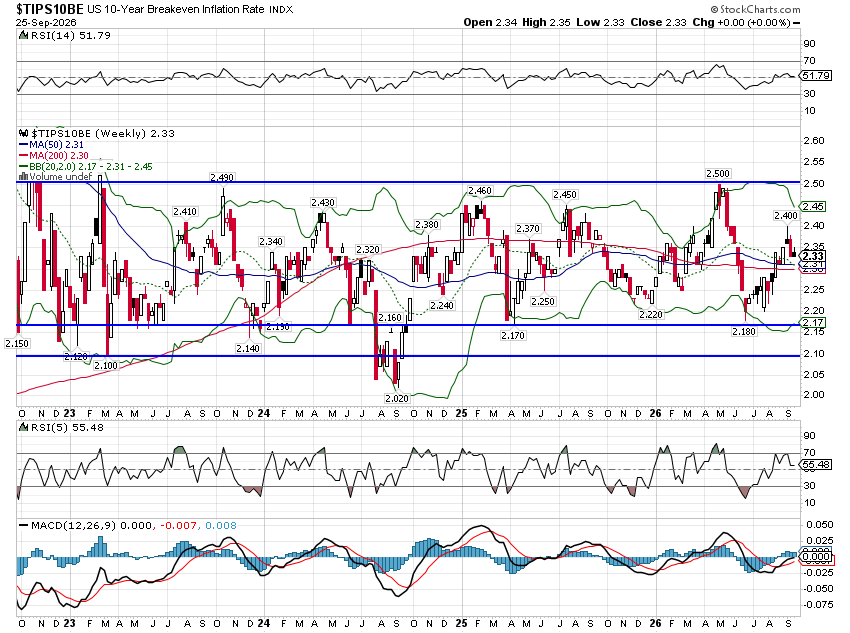
With that move, the 10-year rate is back to normal — right around the 40-year average. The low-rate regime that prevailed since the 2008 crisis is over.
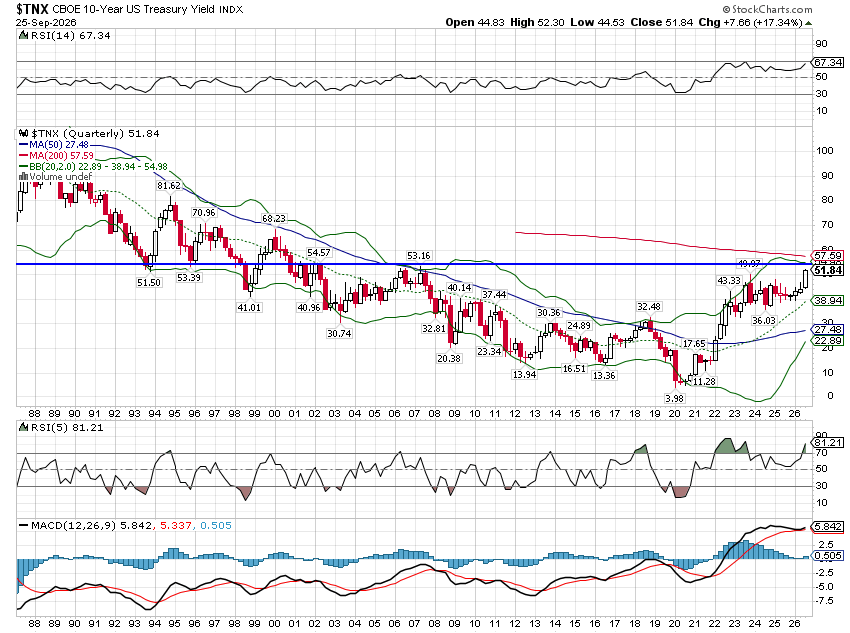
Real rates broke out too. The 10-year TIPS yield hit its highest level since briefly topping 3% in November 2008. The all-time high was 4.41% in January 2000, so real rates could still rise further, and pre-TIPS history (issued since 1997) shows real rates have been far higher before. But long-term, real yields have averaged roughly 3% — so today’s real yields, like nominal yields, are normal too.
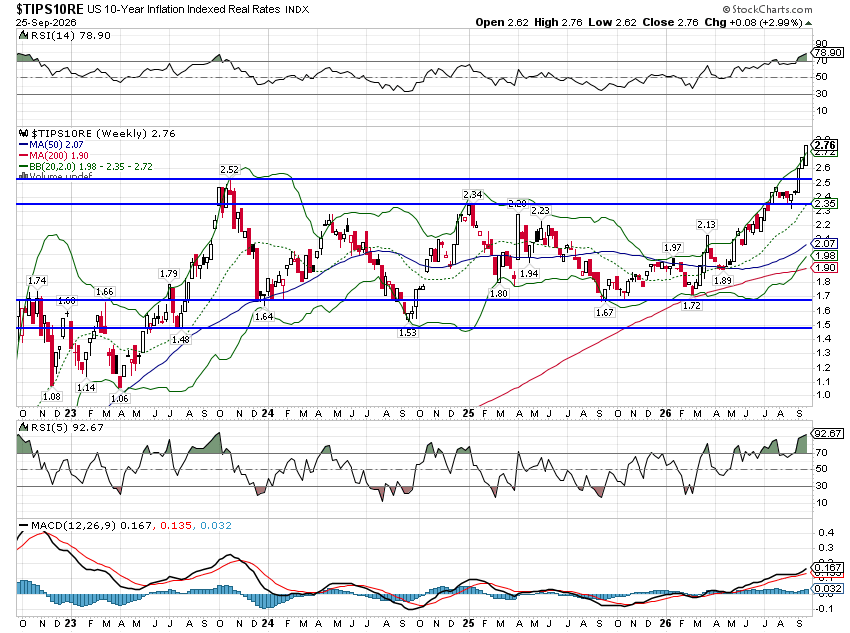
The fact that real yields rose with nominal yields last week means most of the change was about real growth, not inflation. Indeed, the 10-year breakeven inflation rate was unchanged last week.
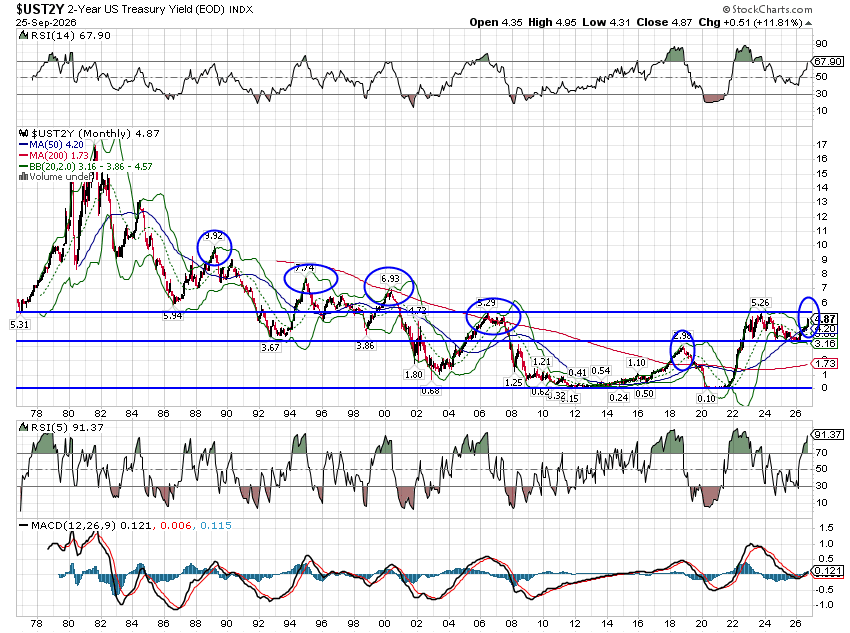
2-year yields also rose and are challenging the 2022/23 highs and the 2007 highs. Short-term rates have now made two successive higher highs across the last two business cycles (if you count COVID as a cycle). That is different than the trend that prevailed prior to the 2008 crisis when each successive business cycle saw rates peak at a lower rate. Rates today are normal if compared to long-term averages but it is in a completely different environment.
There has been a lot of doom and gloom written about this move up in rates with varied explanations, from inflation fears to a loss of confidence in US debt. It isn’t the most popular explanation, but the simplest is that real growth expectations have risen, likely due to optimism about AI driven growth. Additional evidence in favor of the better growth narrative is the recent firmness in the US dollar, which has been very stable since the middle of last year and is now near its recent high. More evidence can be found in the gold market where prices are now in a bear market (down over 20%) since peaking in March of this year. These are not moves one would expect if this rise in rates was being driven by inflation or sovereign fears.
Real GDP growth has been pretty stable since 2022, the year-over-year change averaging right at 2.5%. It has stepped down some over the last year to about 2.3% but that really isn’t enough change to be meaningful. The Atlanta Fed’s GDPNow real time forecasting tool has current quarter real GDP running at around 5% but we are still missing a lot of data for the quarter. If you look at the details, the big positives for the quarter are inventories, consumer spending, and non-residential fixed investment. Some of the inventory change is due to front running of tariffs but not all. I’ve been writing about the fall in inventories relative to sales for months. The consumer has been a lot more resilient than the consumer sentiment surveys suggest.
So, if the rise in rates is about real GDP growth, that’s good, right? That depends on what you mean by good. Economically, rising real growth should be a good thing but we shouldn’t forget that inflation is still well above reasonable. The year-over-year change in NGDP is currently 6.6% with just 2.1% of that real growth and the rest inflation (GDP deflator). If real growth accelerates to, say 3% and the inflation rate stays the same, NGDP would accelerate to over 7% which would probably drive interest rates even higher. If you’re an investor in stocks, that is not good news. The 1970s had great real GDP growth (3.3%/year) but rising inflation and rising rates cut stock valuations in half across the decade; real returns (after inflation) were negative.
In the 1970s, NGDP grew by 11.7%/year and earnings grew by 10.4%/year but stocks fell anyway because interest rates rose. In the 1980s, NGDP grew 5.6%/year and earnings 5.1% but stocks rose because interest rates fell. Stock valuations at the beginning of the 1970s were modestly above the long-term average while valuations at the beginning of the 80s were almost half the long-term average. High starting valuations and rising rates (1970s) produced terrible stock returns (5.8% nominal and -1.6% real). Low starting valuations and falling rates (1980s) produced great returns (17.6% nominal and 12.5% real).
Where are we today? Starting stock valuations are near all-time highs, inflation is higher than average and interest rates are rising. While we can’t predict returns over short-time frames, the Shiller method is pretty accurate in predicting subsequent 20-year returns. Right now, that method produces an expected average real return of 1.0% to 2.5%. We can also use John Bogle’s method:
Expected 20-year real return = Starting Dividend Yield + Real Earnings Growth + Change In Valuation
That gets you an expected real return of 2.0% to 3.5%.
That assumes that valuations go back to their long-term average; this is reversion to the mean. What if inflation falls back to the Fed’s target while AI gets real growth up to 3%? Even if we assume no change in valuations, expected returns are still low. Long-term earnings growth is roughly the same as NGDP growth. If inflation goes to 2% and real growth is 3%, we get NGDP growth of 5%. If we use the Bogle method: Starting Dividend Yield of 1.0% + earnings growth of 5% = 6.0% nominal return. Adjusted for inflation of 2% gets you a real return of 4%. Meanwhile, an investor can get 3.1% real yield from a 20-year inflation protected bond guaranteed by the US government.
I have said in past commentaries that if the 10-year finally moves decisively above 5% that would represent a new environment for investors, different than what has prevailed for the last three years. Bonds – especially TIPS – now offer a competitive return to that of stocks. AI may or may not raise productivity and real growth but even if it does, it will have to be a large rise to make a difference to future stock returns. Furthermore, I expect AI’s impact on economic growth and earnings growth to slow over the next year or two for several reasons. First is that the major AI companies are already calling for a slowing although their reasons for doing so remain somewhat opaque. Second, there remain significant bottlenecks (electricity production most prominently) that will likely slow the buildout whether OpenAI and Anthropic want it or not. And lastly, the likelihood of government regulation of some sort hangs over the industry. We can argue about the need for regulation but I don’t know of anyone who believes more regulation won’t slow development.
As for inflation, we’ll see, but in the past it didn’t stop rising until the 10-year yield exceeded the year-over-year change in NGDP. At 6.6% NGDP growth and a 5.2% 10-year, we aren’t even close. I’m not sure it even matters how that gap is closed. If rates rise, stocks are going to get marked down at some point. If NGDP growth slows, so does earnings growth. Neither would seem all that good for stock prices. And by the way, earnings growth is already likely near a peak. The 2nd derivative of forward earnings estimates has already peaked and is rolling over. Right now S&P 500 earnings are being driven by investment spending. The hyperscalers buy equipment and services to build data centers and that flows out to suppliers as earnings. But soon, the spending will slow and the hyperscalers will have to start depreciating the investments they’ve made over the last few years. Earnings growth is going to slow and may turn negative. The only real question is when.
It’s time to reassess your portfolio. The low rate world of the recent past is gone and it doesn’t look like it’s coming back. If you’re investing experience is limited to the last couple of decades, you should know – this is your father’s market. And it’s a lot different than the one you’ve become accustomed to.

Stay In Touch