
It just goes to show ya. It’s always something. If it’s not one thing, it’s another.
– Roseanne Roseannadanna, played by Gilda Radner on SNL
So, was that it? Is the AI boom over? It seems like just a month or so ago that any stock even vaguely associated with AI was going up on a daily basis. Nvidia was the poster child because their chips are the essential ingredient for AI data centers and no one can compete with them, right? Gross margins of 75% and operating margins of 65% are safe, right? Heck, the stock isn’t even that expensive. With a 1-year forward P/E of about 16, it’s darn near a value stock. And Micron is just a juggernaut, right? Gross and operating margins of 73% and 66% are just going to persist in perpetuity, right? And that earnings growth! Over 1000% higher than the same quarter last year! And it’s even cheaper than Nvidia at only 6 times 1-year forward earnings estimates. The stock is obviously undervalued, right? Nothing like this has ever happened before, right?
Micron Technology, Quarterly YoY Growth of quarterly earnings
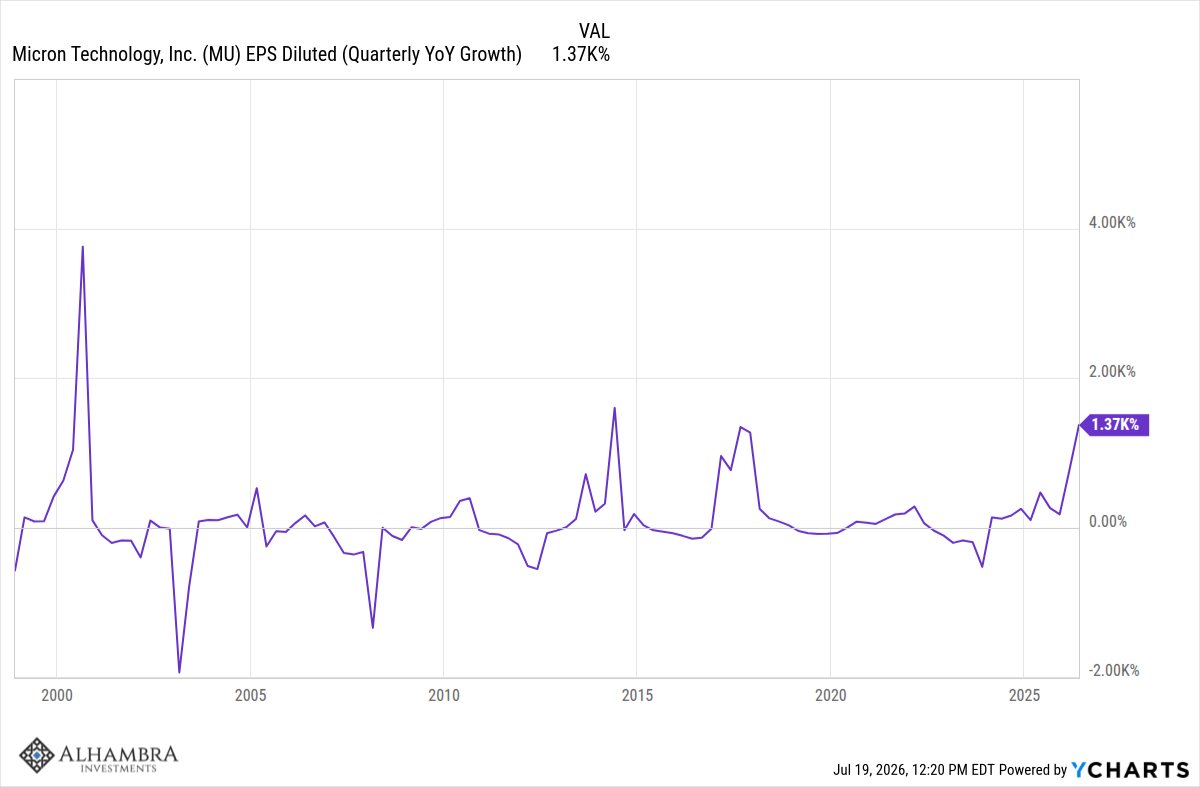
The fact that the 1-year forward P/E for Micron is in single digits actually provides some very useful information. You see, the memory business is very cyclical and the emergence of AI probably isn’t going to change that. It could, I suppose, but only if you assume that the growth spurred by AI is going to repeat every year and that no other companies are going to be enticed by those fat margins. It might take time, but margins like that do not go unchallenged and you don’t put a big forward multiple on cyclical businesses. In fact, if you study history you’ll quickly learn that the time to sell cyclical stocks is when they have low P/Es, like now, and the time to buy them is when their P/Es are negative.
The boom may or may not be over but the AI stocks started topping a couple of months ago and the correction has only gained steam since Nvidia peaked in mid-May (yes, really). It has subsequently fallen a fairly mild 15%. Others in the AI orbit haven’t been so lucky. The correction has been broad based:
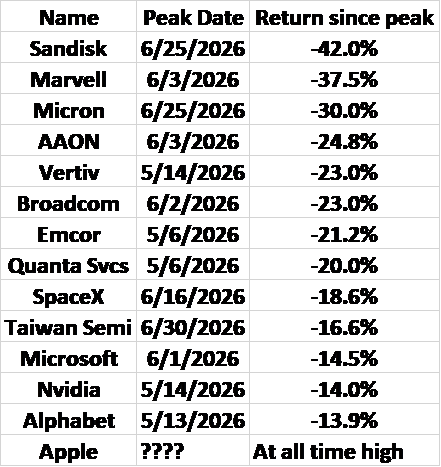
I included Apple in this list for a reason. Apple isn’t spending on AI like the rest of Silicon Valley and they probably won’t. Apple sees AI as a tool it will use in its products, not a product in itself. They aren’t in the traditional cloud business like Alphabet, Microsoft, and Amazon and they don’t want to be in the “neo” cloud business of renting out excess data center capacity. Meta has already shifted to that model because they couldn’t build an AI model to compete with the others – quelle surprise – and other, smaller players are following suit. That neatly fits in with the recent release of the open weight models out of China. These are the open source versions of AI and when run on rented compute capacity, can undercut the cost of closed API models, like those from OpenAI and Anthropic, by 60-70%.
This brings up an interesting conundrum for investors. The Chinese open weight models can be downloaded for free but you still need the hardware capacity to run them, which explains Meta’s shift in strategy. That’s obviously bad news for Anthropic and OpenAI who have built their business models on captive customers using proprietary models on hardware they control (if not own). The closed API model only works if they can charge a premium price for access to their models. Now that the open weight models have caught up in sophistication – reviews are that Moonshot’s Kimi is as good as Claude Fable 5 – they offer some major advantages over the closed API versions offered by OpenAI and Anthropic. While the closed API versions make your internal data vulnerable, the open weight model can live on your own private infrastructure (only large companies are going to be able to afford that but still), offering complete security. You can also adjust the model however you want once you’ve downloaded it. Even if the open weight models aren’t quite as good, they can handle the vast majority of business use cases.
The emergence of open weight models is a big threat to the AI model builders who want to run a walled garden of their own models. They will have some high margin business because, at least so far, the US AI model companies continue to have an advantage over their open weight competitors. For bleeding edge math or advanced cybersecurity defenses or some forms of programming, companies will still have to pay OpenAI and Anthropic. Maintaining that edge is expensive though and turning a profit large enough to justify their investments only from frontier models seems suspect.
The hardware side of the AI equation isn’t a slam dunk either. The ROI on AI right now, outside of programming, is mostly speculative. I’ve said all along that it is going to take time for companies to figure out how to use AI effectively and based on what we’ve seen so far, most companies haven’t even come close. If they don’t start seeing results soon, demand is likely to fall; CEOs’ and other execs’ compensation is tied to corporate performance. For investors, this means that we have no idea what the end demand for computing power will be. For all we know the amount already on the drawing board is too much. If it isn’t, there is no guarantee that more can be built in a timely manner; AI nirvana may be late.
About half of the data center capacity originally scheduled to come online over the next two years has been delayed or canceled, mostly due to a lack of electrical grid and generating capacity. Companies facing up to 5-year delays in connecting to the grid have shifted to “behind the meter” sources (building local power sources that bypass the grid) like gas and diesel generators and fuel cells. Caterpillar has seen a surge in demand for both diesel and natural gas generators. This doesn’t solve the power problem though, as you still have to get fuel to the facilities and natural gas pipelines and laterals don’t happen overnight. Diesel prices have also spiked as refinery facilities in the Middle East and Russia have been damaged by the wars there.
There is debate over how much new generating capacity will be needed – because we don’t know what end AI demand will be – but I’ve seen estimates of as much as 250 GW over the next five years. Currently, the regulated utilities who will provide most of this power are on track to add just 93 GW. As for the grid, the average time to get approved for connection is about 5 years. Furthermore, adding transmission lines across state lines is a nightmare of state and local permitting. There’s also a backlog of orders for things like transformers (3 to 4 years), grid scale gas turbines (good luck getting one before 2030), and behind the meter gas generators (Caterpillar’s lead time is currently 107 weeks) just to name a few critical items. Expanding electrical capacity happens at the highly regulated utility speed, not Silicon Valley speed.
To bring this back to investing, after a 20-40% correction in the AI stocks (and that doesn’t include some of the smaller companies that have fallen a lot further), do you buy the dip? If you haven’t been in these names, do you take this as a buying opportunity? Before you answer that, let me remind you that it isn’t just the problems with AI you need to worry about. It’s always something and usually more than a few somethings:
- The Iran war and energy prices. Oil prices are on the rise again and with the strait of Hormuz essentially closed, expectations are that prices could rise more. On the other hand, the reduction in refinery capacity means that the supply of crude oil may not be the limiting factor. Gas and diesel prices didn’t fall nearly as much as crude oil prices during the “ceasefire”. How will higher energy prices affect the global economy? What if it is accompanied by a glut of crude?
- Inflation isn’t just about energy prices either. Food prices have continued to climb and with the loss of ME fertilizer supply due to the strait closure, I wouldn’t expect relief anytime soon.
- Tariffs continue to snarl supply chains and raise prices. What will the new tariffs about to be announced by the administration look like?
- Interest rates are near the highs of the last four years. Will they finally break out and go higher? Or will NGDP slow and bring rates back down?
- What will the Fed do? Kevin Warsh has made it clear that transparency isn’t at the top of his to-do list. Futures markets have flipped from expecting rate cuts at the beginning of the year to expecting multiple rate hikes by year end. And Warsh has also indicated he wants to shrink the Fed’s balance sheet. How will those things affect the economy? Liquidity?
- How will the mid-term elections affect the make up of Congress? Could the Democrats gain a majority in one or both houses of Congress? What would that mean for the Trump administration’s agenda?
- Government debt is closing in on $40 trillion. Will the world continue to finance US deficits? At what cost?
- Real disposable personal income peaked in April of last year and has fallen steadily in recent months. Can high income earners continue to carry most of the load? Will middle and lower income households continue to draw on savings to maintain consumption?
Those are just some of the known potential issues, the things we know we need to worry about. What about the unknown unknowns, the black swans? Is there something out there that could derail the global economy that isn’t on our radar right now? What about a breakthrough in quantum computing that renders current digital security obsolete? How about a digital supply chain virus that targets legal contracts? How about another pandemic? The list of potential pitfalls is endless.
Investors constantly face risks and uncertainties. They aren’t the same thing but they are often confused. Risk is a situation where you don’t know the exact outcome, but you do know the underlying mathematical probabilities, a roll of the dice, flipping a coin, or anything that uses historical data to calculate probabilities. Risk can be modeled, calculated, and priced. Uncertainty is a situation where the outcomes are so unique, novel, or complex that it is mathematically impossible to calculate or assign a reliable probability, like predicting the long-term societal impact of a completely unprecedented technology, or the economic impact of a sudden geopolitical event. Uncertainty cannot be calculated or insured against.
We can’t calculate the uncertainty around the AI boom. It may raise productivity across the entire economy or it might be confined to areas like software development. We can’t calculate the proper amount of data centers to build. We can’t know how much new electrical generating capacity to build. We don’t know if the emerging bottlenecks to more compute capacity will be a limiting factor or will prove serendipitous by preventing overbuilding. We don’t know if the various geopolitical conflicts will cause a shortage of crude oil or a glut because there isn’t sufficient capacity to refine it. The list of things we don’t and can’t know in advance is always long.
Financial markets operate mostly in the realm of uncertainty, not calculable risk. Attempting to model that uncertainty or relying solely on historical probabilities is a trap because probabilities are not certainties and models may be useful but reality is a messy place. The only real protection for an investor is to build a portfolio that is resilient and provides tactical flexibility. You do that through diversification, spreading your capital across multiple asset classes and geographies so no single failure can cause a catastrophic loss. You do that by thinking long term and acting contrary to the crowd, reducing your exposure to assets that are loved by everyone and adding to those that are universally abhorred. Investing isn’t about predicting the next storm. It’s about building a portfolio that will survive the storm so you can reach your financial goals.
It’s simple but it isn’t easy.
Joe Calhoun

Stay In Touch